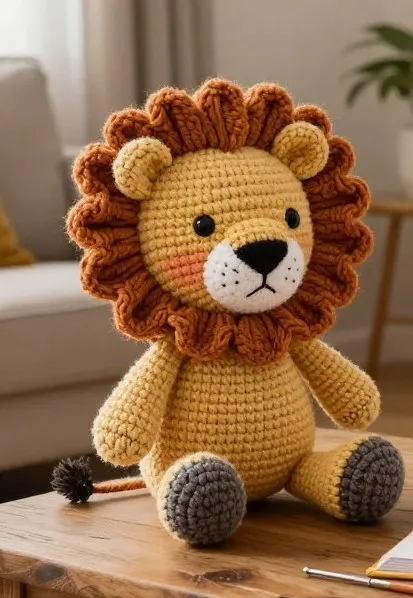
A small amigurumi, a standing plush, or a lion-themed blanket can each suit a different skill level and gift purpose; crochet lion patterns offer all three formats. The best choice depends on the yarn, construction, and intended use. A small toy may be a quick handmade present, while a blanket can become a cozy keepsake.
Think about who will receive the gift and how they might use it. The right project can feel special without asking you to take on more than you want. You can compare formats, materials, skills, and care needs to find a manageable match.
Key Takeaways
- Choose a small amigurumi for a compact cuddly toy.
- A larger plush takes more yarn and time than a small toy.
- A lion-themed blanket offers a useful alternative to a stuffed project.
- Yarn weight and hook size affect the finished size.
- For a baby gift, choose soft embroidered or yarn facial details.
- Follow the care instructions for the yarn in your project.
Choose for the recipient’s age and the kind of finished project they will actually use.
Which Crochet Lion Patterns Fit Your Project?
A small amigurumi is the most direct choice for someone who wants a cuddly toy, while the blanket suits a different kind of handmade gift. Pick the format that fits the gift’s purpose, then compare the time and materials involved.
Small Amigurumi for a First Toy
Landon the Lion and the Red Heart Free Crochet Lion Amigurumi Pattern are compact toy options. Landon can be made in different yarn weights, while Red Heart describes its free crochet lion pattern as easy for beginners. Its small finished form makes it a practical choice when you want a classic stuffed lion.
A free lion crochet pattern can suit a maker who wants a toy without paying for instructions. A separate listed Lion Crochet Pattern costs $8.95, so it is a paid option rather than a free crochet pattern.
Larger Plush and Blanket Options
Laurence the Lion and the Mix & Make plush lion provide larger stuffed-toy formats. The Crochet Lion Baby Blanket offers a flat, useful gift: it measures about 30 by 30 inches, uses a size H hook, and has 18 rounds around two joined squares. Four Cafe Latte pom-poms finish its corners.
- Landon the Lion: a small toy with more than one yarn-weight option.
- Red Heart’s free lion pattern: an easy beginner amigurumi.
- Laurence the Lion: a standing plush with a yarn-strand mane.
- Mix & Make: an approximately 8-inch plush lion.
- Crochet Lion Baby Blanket: two joined squares and four corner pom-poms.
The listed $8.95 Lion Crochet Pattern is a separate paid option, not a free pattern.
The Red Heart toy finishes about 9 inches tall by 5 inches wide, including its legs. Use matters: choose a toy for cuddling or a blanket for warmth and everyday use. Match the format to the recipient’s use before comparing yarn and hook requirements.
Choose Yarn and Hook Size for the Finish
The same Landon design ranges from a small worsted-yarn toy to a noticeably larger super-b bulky plush. Gauge is the number of stitches and rows in a set measurement, used to check whether your finished work will match the pattern’s size. Yarn weight and hook size together affect both the fabric and finished dimensions.
| Yarn setup | Yarn weight | Hook | Finished size and listed color yardage |
|---|---|---|---|
| Landon the Lion | Medium-weight (4) worsted | 4.0 mm (G) | 5 inches sitting or 7 standing; 66 yd yellow, 14 yd cream, 22 yd brown |
| Landon the Lion | Super-bulky (6) | 5.0 mm (H) | 8 inches sitting or 11 standing; 90 yd yellow, 21 yd cream, 27 yd brown |
| Laurence the Lion | Acrylic weight-4 | 3.5 mm (E-4) | 13.5 inches standing; 185 yd yellow, 32 yd cream, 3 yd brown, 138 yd orange |
Changing the yarn can change the finished size, so changing only the hook may not produce a reliable match. Vanna’s Choice solids are 100% acrylic, medium-weight (4), and provide 170 yards per 3.5-ounce skein.
Its listed gauge is 12 single-crochet stitches by 15 rows over 4 inches with a 6 mm (J-10) hook. A crochet pattern may specify a different setup, so use its own instructions when size matters. Make a small test swatch when matching a stated gauge matters to the finished size.
Skills That Make Amigurumi Easier
Most amigurumi patterns rely on a short set of repeatable skills rather than a large stitch vocabulary. Round counts matter, even in an easy crochet pattern. Landon is rated advanced beginner, while the Red Heart pattern is described as easy and uses basic stitches.
Reading Rounds and Stitch Abbreviations
Many toy patterns are worked in continuous rounds, which means you keep crocheting around without joining each round with a slip stitch. Use stitch markers to track where a round begins. Instructions may shorten single crochet to “sc” and stitches to “sts”; follow each round’s count as written.
A magic ring creates a tight center that can be pulled closed. Landon begins its rounds with 6 single crochet in a magic ring. This starting point helps close the top of a small piece without leaving a large hole.
- Make a magic ring and close its center.
- Work single crochet stitches evenly.
- Use an invisible decrease to shape a piece.
- Work in continuous rounds while tracking each start.
Shaping and Gauge
Shaping comes from adding or reducing stitches in planned places. Laurence is rated intermediate and uses continuous rounds without joining. Its stated gauge is 30 single-crochet stitches by 5 rounds over 2 inches.
Landon does not require a gauge check, while Laurence provides a specific gauge. Follow the round counts carefully even when a pattern is labeled beginner-friendly. An easy label describes the expected skill level, not permission to skip instructions.
Pause at the end of a round to compare your stitch total with the pattern. That quick check can catch a missed increase before the piece grows several rounds out of shape. Mark the beginning of each round so a missed or added stitch is easier to catch.
Build and Assemble the Lion
Pin each piece in its intended position before sewing so you can check the lion’s balance and expression. Temporary pins let you adjust the shape before a seam becomes permanent. Stuff pieces evenly as you work when the pattern calls for it.
Adding stuffing while a piece is still accessible can help you reach its narrow areas. Use small amounts and shape them with your fingers rather than pushing in one large lump. Landon’s body, head, legs, and arms are stuffed, but its ears stay unstuffed.
For Landon, embroider the nose across about 5 stitches. Its legs attach over body rounds 4-5, and its arms attach over rounds 11-15. Treat those placements as pattern-specific guides, not universal locations for every crochet lion.
Laurence’s body joins to its head with a yarn tail about 65 inches long. A longer tail gives you room to sew around the seam without running out midway. Keep the joining yarn neat and avoid pulling so tightly that the fabric puckers.
Check that the head faces forward and the legs sit evenly before securing the final seam.
Customize the Mane, Shape, and Expression
The mane has the biggest effect on a lion’s expression, so changing its texture can make the same basic shape feel different. A small change in yarn or stitch style can shift the look without changing the whole amigurumi pattern.
- Change the mane texture with loops or strands.
- Choose a contrasting mane color for a bold outline.
- Embroider facial features for a soft, stitched expression.
- Select another body shape when the pattern offers one.
Landon’s mane uses chain-8 loops, which create a curled, dimensional edge. Laurence’s mane uses more than 570 strands of 6-inch yarn for a shaggy fringe. Those methods give the same animal a different feel, even when the face and body remain familiar.
The Mix & Make version has three body versions and allows 35 g of faux-fur yarn for its mane. For that version, the mane uses a double crochet instead of a chain-7 loop. That substitution belongs to this pattern’s instructions; faux fur will not behave identically in every crochet lion pattern.
Embroidery gives you control over small facial details, and a contrasting color can make the mane stand out against the body. If you change the body shape, keep the pattern’s instructions in view so the pieces still fit together. Test a new mane yarn on a small section before committing to the full mane.
Safety Rules for Toys Made for Young Children
For a baby gift, use embroidered, felt, or yarn facial details instead of safety eyes or a plastic nose. Soft details avoid adding hard pieces that can come loose. Safety eyes and noses pose a choking risk for babies.
Safety Eyes and Soft Facial Details
Yarn, felt, or embroidery can create eyes and noses without plastic parts. A handmade-toy suggestion is not proof that a product meets federal requirements. Rules depend on the product’s intended age group and the hazards it presents.
Rules for Products Intended for Children
The CPSC small-parts ban applies to children’s products intended for children under 3 when a small part presents a choking, aspiration, or ingestion hazard. CPSC considers the maker’s stated intent, advertising, promotion and marketing, and common recognition when deciding whether a product is intended for that age group.
| Topic | Rule or standard | Applicable detail |
|---|---|---|
| Intended age and hazard | 16 CFR part 1501, Small parts | Ban applies to covered products for children under 3 with a small-part hazard |
| Small-parts cylinder and dimensions | Small-parts test | 2.25 inches (57.10 mm) long and 1.25 inches (31.70 mm) wide; part fits fully without compression in any orientation |
| Certification and testing | CPC; ASTM F963, 16 C.F.R. part 1250 | Third-party testing for sections 4.27 and 4.35 |
Manufacturers and importers of products subject to a CPSC-enforced rule, standard, or ban must issue a Children’s Product Certificate (CPC). Toys designed or intended primarily for children 12 or younger are subject to CPSC testing and certification requirements. ASTM F963 section 4.27 covers stuffed and bean-bag-type toys; section 4.35 covers pompoms.
- Decide the toy’s intended age group.
- Inspect for detachable small parts.
- Confirm applicable testing and certification requirements.
Ask the CPSC or a qualified product-safety professional about obligations for a toy you plan to sell.
Care for the Finished Crochet
Check the care instructions for the actual yarn in your project before washing the finished toy. Yarn labels differ, even when two fibers look similar. Follow the instructions for every material used in the finished work.
Vanna’s Choice is machine washable and machine dryable. Red Heart Super Saver care instructions call for warm-water machine washing on a gentle cycle, then tumble drying on low. They also say not to bleach or iron the yarn.
For a mixed-fiber project, follow the care instructions for its most delicate component.
The lion pattern’s yarn may have different care needs from another yarn you choose. Check the labels for the body, mane, and any added fabric before washing the whole piece. A setting that suits one fiber can be too rough for another.
Use a gentle wash method when the yarn instructions allow machine washing, and avoid heat beyond the stated drying guidance. Do not put a damp stuffed toy into a closed storage bin, where moisture can linger in its filling.
Let the toy dry completely before putting it away or returning it to a child.
Conclusion
A well-chosen lion project is one that fits both the recipient and the time you want to spend making it. The right format also matches your comfort with amigurumi, whether you want to make a small toy, a plush, or a blanket.
Choose a pattern with instructions that fit your skills and the way the finished gift will be used. Then select the materials listed for that design, rather than guessing at a substitute when size matters.
Choose your pattern, gather its listed supplies, and begin with the first round.
FAQ
Can I substitute a different yarn in a crochet lion pattern?
Yes, you can substitute yarn, but a different yarn weight can change the finished size. When the size matters, match the pattern’s gauge rather than relying on the hook alone. Fiber and texture can also change the fabric’s feel and appearance. Check that you have enough yardage in each color before starting, especially if your substitute has fewer yards per skein.
How much yarn does a crochet lion need?
The amount depends on the pattern and the finished size. Landon’s medium-weight version uses 66 yards of yellow, 14 yards of cream, and 22 yards of brown. Its super-bulky version uses 90 yards of yellow, 21 yards of cream, and 27 yards of brown. Check the specific pattern’s color list before buying, since each design uses different amounts.
Can I use faux fur for a crochet lion’s mane?
Yes, the Mix & Make version allows 35 g of faux-fur yarn for its mane. Its instructions replace a chain-7 loop with a double crochet for that version. Do not assume the same substitution will work in another pattern, since stitch construction and yarn texture can change how the mane sits. Test a small section first.
How do I keep stuffing from showing through amigurumi stitches?
Use a smaller hook than the yarn label recommends when needed, and keep your tension tight and even. If gaps still show, check that the hook and yarn combination creates a dense fabric without making the stitches difficult to work. Add stuffing in small amounts; pressing in too much can stretch the stitches and make the filling visible.
Can I machine wash a crochet lion?
Check the care instructions for the yarn used in the project. Vanna’s Choice is machine washable and machine dryable. Red Heart Super Saver instructions specify warm-water machine washing on a gentle cycle and tumble drying on low, with no bleaching or ironing. A mixed-fiber toy should follow the care directions for its most delicate component.
Are safety eyes safe for a baby’s crochet toy?
No, safety eyes and noses pose a choking risk for babies. Use yarn, felt, or embroidered facial details instead of plastic pieces. Soft features can still create a clear expression without adding detachable hard parts. If you plan to sell a toy for young children, decorative choices alone do not establish that the product meets applicable safety requirements.
Do I need to check gauge for every amigurumi pattern?
No, not every amigurumi pattern requires a gauge check. Landon does not require gauge, while Laurence specifies 30 single-crochet stitches by 5 rounds over 2 inches. When a pattern gives a gauge and the finished size matters, make a small swatch and compare it with the stated measurement before continuing.