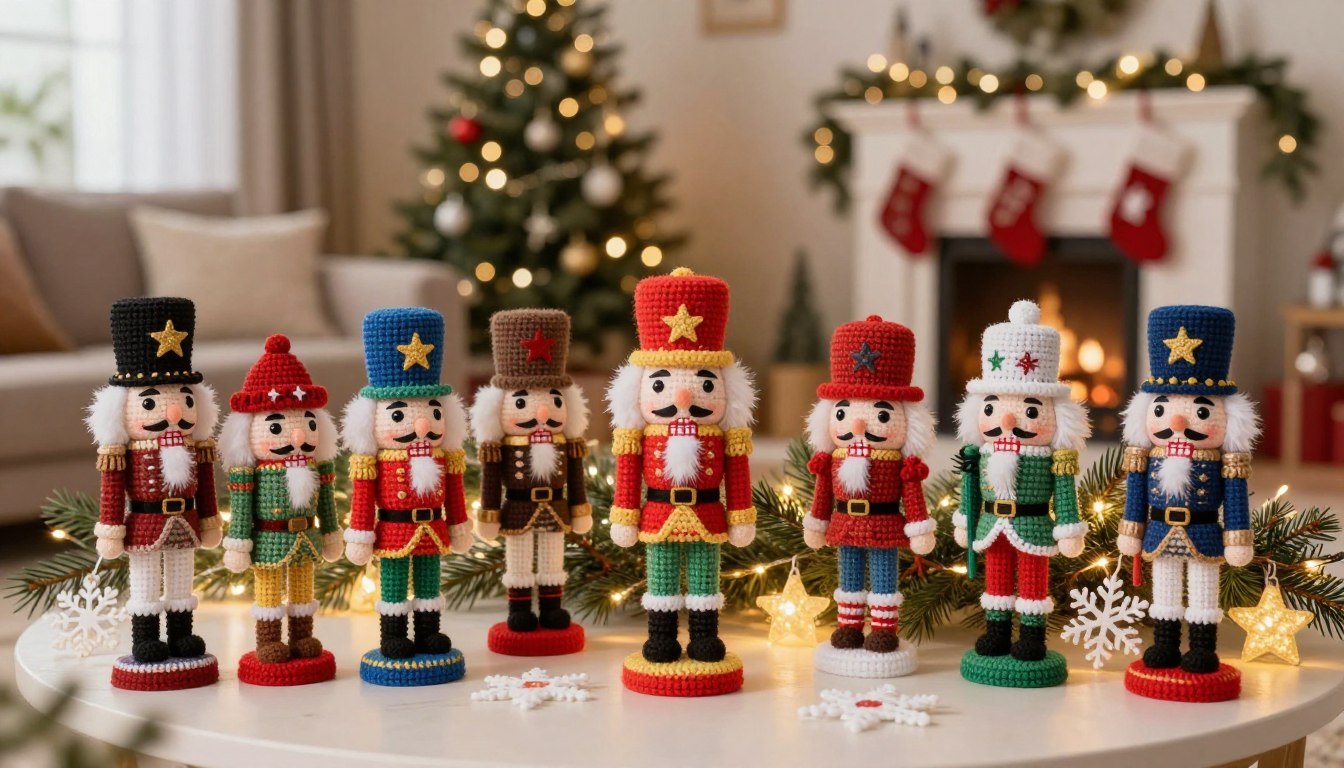
These 15 patterns range from small beginner dolls to detailed display figures, character sets and a graphgan, so you can match a project to your skill level and holiday plans. The Cutest Nutcracker Christmas Crochet Patterns You’ll Ever See includes choices for crocheters planning holiday decor, Christmas crafting or handmade gift ideas. Amigurumi is a crocheted or knitted stuffed toy or figure.
You can choose from stuffed soldier dolls and gnomes to ornaments and a charted block. Yarn weight and hook choice can change a finished figure’s dimensions, so follow the pattern’s details when planning your project. The right design depends on your intended use and the construction you feel ready to tackle.
Key Takeaways
- Choose a stuffed figure for a three-dimensional display or gift.
- Character sets offer coordinated figures, while ornament patterns suit smaller decorations.
- A graphgan block gives you a charted option instead of a stuffed doll.
- Skill ratings and construction notes help you select a manageable project.
- Yarn weight and hook choice can affect the finished dimensions.
Choose a design for the way you want to use it, whether that means a shelf display, a handmade gift or a festive accent.
The Cutest Nutcracker Christmas Crochet Patterns You’ll Ever See for Every Skill Level
The quickest way to shortlist these 15 patterns is to decide first whether you want a stuffed figure, a group of characters, an ornament or a charted crochet project. The collection spans several forms, so your preferred project type can narrow the choices before you compare details.
| Pattern name | Project form | Distinctive appeal |
|---|---|---|
| Crochet Nutcracker Gnome | Stuffed gnome figure | Soldier styling paired with a tall gnome hat |
| CB’s Creations Nutcracker Soldier | Stuffed soldier doll | Classic uniform and recognizable face details |
| Candyland Nutcracker | Novelty stuffed figure | Whimsical candy-inspired character design |
| Elisa’s Crochet Nutcracker | Compact stuffed doll | Fur detail adds texture to the uniform |
| Tuoi Duong Thi’s Nutcracker doll | Small stuffed doll | Soft chenille or velvet yarn suits a plush look |
| Crochet365Knittoo Nutcracker | Stuffed soldier doll | Separate legs join to form the body |
| Theo the Nutcracker | Detailed stuffed figure | Decorative finishing and a structured base |
| TheCrochettisti Nutcracker | Uniform-style doll | Cotton construction with a tall hat |
| Kate McCully’s Amigurumi Nutcracker | Stuffed doll in two scales | Includes a small version and an oversized version |
| Yarnington Amigurumi Christmas | Three-character set | Nutcracker, Mouse King and Tin Soldier designs |
| Noel and North the Nutcracker bundle | Two-figure bundle | Includes video tutorials for two figures |
| Nutcracker Crochet Ornament Collection | Six-character ornaments | Six figures designed as tree decorations |
| Victor the Nutcracker | Stuffed soldier doll | Intermediate design with a classic silhouette |
| The Crafty Nutcracker | Stuffed soldier doll | Tall doll format for holiday decorating |
| The Nutcracker Prince Block | Charted crochet block | Pixel chart for a flat motif or graphgan |
Match a pattern to your preferred project form
Start with the finished object you want to hold or display. A stuffed amigurumi figure gives you a freestanding character, while a character set creates a coordinated group. An ornament is a smaller decoration, and a graphgan block turns the Nutcracker theme into a charted crochet project.
Choose by construction, not appearance alone. Two soldier dolls may look alike in a finished photo, yet one can involve separate limbs, detailed clothing or extra assembly. A charted square calls for a different working rhythm than a stuffed figure worked in rounds.
Compare construction and standout details at a glance
Use the table to spot the form and design feature that appeal to you, then read the pattern description for its actual construction. Look for whether pieces are worked separately, whether the design includes a full character set, and whether the result is meant to be stuffed or kept flat.
A crochet pattern’s skill label can help, but it does not explain every technique or finishing step. Pay attention to the stitches and assembly the instructions name, especially if you have not made an amigurumi before.
Pick the project form first, then judge whether its construction fits your experience and available crafting time.
Keep the table as a shortlist, then compare the pattern’s finished size and materials with your available space and supplies.
Larger figures for a bold holiday display
For a shelf or mantel focal point, start with the Crochet Nutcracker Gnome, the CB’s Creations Nutcracker Soldier or the Candyland Nutcracker. These larger crochet figures bring strong display presence, though their construction and materials differ.
The gnome measures about 14.5 inches from foot to hat knob with a Size E/4 hook. Without the knob, it measures about 13.5 inches. Its first six body rounds measure about 2 inches across when worked with that same 3.5 mm hook.
The gnome pattern is rated intermediate and uses worsted-weight size 4 acrylic yarn with a Size E/4 (3.5 mm) hook. The knob changes the height measurement, so decide whether you want to include it when comparing the figure with a display space.
CB’s Creations Nutcracker Soldier measures 33 cm and uses cotton yarn in skin, black, white, yellow or gold, and blue. The design also calls for white acrylic hair, a 2.5 or 3 mm hook, and 8 mm safety eyes.
Its listed stitches are familiar basics: magic ring, single crochet, slip stitch and chain. That makes the soldier’s stated stitch requirements more approachable than the gnome’s intermediate rating, though you still need to follow the full assembly instructions.
Candyland is a tall, novelty-style figure at approximately 36 cm, or 14 inches. Its playful scale makes it a statement piece rather than a subtle accent, with a different look from the more traditional soldier dolls.
Compare the height figures carefully because the gnome’s measurement changes when its top knob is excluded. The soldier’s listed height gives you another reference point, while Candyland offers a taller novelty character.
Check the height from the figure’s base to its highest feature against the shelf or display area you plan to use.
Smaller dolls for approachable holiday makes
If you want a compact project, Elisa’s Crochet Nutcracker and Tuoi Duong Thi’s Nutcracker doll are both rated beginner. Their different yarn recommendations give you a choice between defined detail and a softer, plush finish.
Elisa’s Crochet Nutcracker measures 10 inches high by 3.5 inches long. It uses light yarn weight 3 for the doll, super bulky fur yarn weight 6 for its fur, a 2.5 mm hook and two 6 mm plastic safety eyes. The mix of yarn weights creates a noticeable texture contrast.
Tuoi Duong Thi’s Nutcracker doll is approximately 14 cm, or 5.5 inches, tall. Its pattern recommends chenille or velvet yarn with a 2.5 mm hook and a 3.0 mm hook for the project. That yarn choice gives the small doll a different surface from Elisa’s fur-trimmed design.
Both beginner ratings refer to those named patterns; they do not automatically apply to every small nutcracker doll. A compact finished figure can still involve shaping, color changes or assembly that you may find unfamiliar.
Crochet365Knittoo’s Nutcracker is approximately 6.5 inches tall, excluding the hat. It uses worsted-weight yarn, a US G 6/4.0 mm hook and 9 mm black safety eyes.
The pattern works the legs separately, then joins them to form the body. It also includes instructions for a soldier hat, so the stated height does not include that top detail.
Before you begin, note which part of the figure each pattern uses as its measurement point. That small distinction matters when you plan a gift box or choose a spot for display.
Compare the stated measurement points before assuming that a hat or other top detail is included in a finished-height figure.
Detailed uniforms for patient crocheters
For a detailed uniform and decorative finishing, Theo the Nutcracker is the advanced choice, while TheCrochettisti’s design is rated intermediate. Kate McCully’s Amigurumi Nutcracker offers two distinct scales for crocheters who want more choice.
Theo is the most demanding option here, with an estimated making time of 12-15 hours. It uses cotton 4-ply yarn and a 2.20 mm hook. Its listed extras include a pair of 5 mm safety eyes and four wooden buttons measuring 1 cm.
Theo’s small hook and decorative components make this a project for patient, careful work. Uniform trim and accessories add finishing tasks beyond crocheting the main figure, so allow enough time to complete those details neatly.
TheCrochettisti Nutcracker uses Scheepjes Catona cotton and a 2.5 mm hook. It measures approximately 30 cm with the hat, and the finished size can vary with yarn and hook choice.
Its intermediate rating places it between a beginner-rated doll and Theo’s advanced design. Cotton yarn gives the uniform a clear, firm look, while the hat contributes to the stated overall height.
Kate McCully’s pattern includes a 20 cm version made with a 2.5 mm hook and 7 mm safety eyes. Its oversized version measures 75 cm and calls for an 8 mm hook and 22 mm safety eyes.
Those versions use different hook and eye sizes, so treat them as separate supply plans rather than assuming one materials list fits both. The oversized figure also offers a very different display scale from a small shelf doll.
Choose a scale before buying or gathering supplies, since the Kate McCully design calls for different hooks and eye sizes across its two versions.
Character sets and ornaments for more than one figure
Choose a character set if one completed figure feels too solitary for your tree or holiday display. Yarnington Amigurumi Christmas gives you three distinct characters, while bundles and ornament collections offer other ways to make more than one.
Yarnington’s set includes a Nutcracker, Mouse King and Tin Soldier, each designed as part of a coordinated group. The figures measure approximately 12 inches and use medium 4 worsted-weight yarn, an F (3.75 mm) hook, and 9 mm doll eyes, beads or buttons.
Noel and North the Nutcracker bundle makes two figures, in 12-inch and 16-inch sizes, and includes video tutorials. It suits a paired display, with two different heights to arrange together.
The Nutcracker Crochet Ornament Collection takes a smaller route, with six characters about 6.5 inches tall. A group of ornaments can give a tree a consistent theme without requiring a single large centerpiece.
A set can support coordinated decorating or provide several handmade gifts. You might make a group for one home, or divide the finished figures among people on your gift list.
Check the finished size of each component before planning a display. A set may include figures of different heights, and ornaments need room to hang without crowding nearby decorations.
Think through how many pieces you actually want to make before choosing a multi-figure pattern. A larger set offers variety, but it also means more separate figures to complete.
Make a simple count of the recipients or display spots you have in mind before committing to a multi-figure set.
A classic soldier, a taller figure and a charted option
If you want a recognizable soldier silhouette but prefer to choose between a doll and a charted project, this group offers both. Victor the Nutcracker and The Crafty Nutcracker are three-dimensional doll options, while The Nutcracker Prince Block is chart-based.
Victor the Nutcracker is approximately 13 inches tall and rated intermediate. That rating gives you a clear skill reference for this doll, though it does not tell you how the other patterns compare.
The Crafty Nutcracker measures about 13.4 inches. Its listed height places it in a similar display range to Victor, but the pattern’s construction details are separate from Victor’s stated rating.
The Nutcracker Prince Block changes the project format altogether. It is a charted crochet motif rather than a stuffed figure, so the finished work can become part of a larger graphgan.
The block graph measures 25 × 25 pixels. That chart gives you a defined square design, not a freestanding character with a body, arms and hat.
Victor’s intermediate label is stated for Victor alone. No skill rating is provided here for The Crafty Nutcracker or The Nutcracker Prince Block, so do not transfer that label to those projects.
Consider where the finished piece will go as well as how you like to crochet. A doll suits a shelf or tabletop, while a charted motif can join a blanket or another flat project.
Decide whether the finished object should be a three-dimensional character or a flat crochet motif before choosing between these formats.
Which project format fits your holiday plans?
Choose the project form by deciding where the finished piece will live and whether you want a stuffed object or a flatter decoration. Placement and shape can narrow the options quickly, from a shelf doll to a blanket block.
A stuffed figure works best when you want a dimensional character, while a graphgan block suits a flat textile project. Use this comparison to match each format with a holiday use.
| Project form | How it is made | A suitable holiday use |
|---|---|---|
| Stuffed amigurumi figure | Crocheted pieces form a three-dimensional toy or figure | Shelf, mantel or tabletop decoration |
| Character set | Several related figures are crocheted as a group | Coordinated display or multiple gifts |
| Ornament | A smaller crocheted character is made to hang | Christmas tree decoration |
| Graphgan block | A chart guides stitches into a flat square motif | Block in a seasonal blanket |
The Nutcracker Prince Block uses a 25 × 25-pixel graph. Its charted format makes it a different kind of crochet project from a stuffed nutcracker.
Before settling on a pattern, answer these three practical questions:
- Where will the finished piece go?
- Should it be three-dimensional or flat?
- Do you want one figure or a set?
Measure the intended shelf, tree or wall space before committing to a large display piece.
Match yarn weight and hook to the fabric you want
Start with the yarn weight named in the instructions, because changing it can alter both the fabric and the finished figure. A different yarn weight can change how firm the stitches feel and how clearly small details show.
Keep the stated yarn weight and hook together unless you are ready to test the fabric. This matters especially for amigurumi, where stuffing sits behind the stitches.
| Yarn category | Common example in this collection | Practical fabric consideration |
|---|---|---|
| Medium or worsted yarn | Size 4 acrylic or cotton yarn | Creates a familiar, substantial fabric for small figures |
| Light yarn | Light yarn weight 3 | Can produce finer stitches and smaller details |
| Bulky or fur yarn | Super bulky fur yarn weight 6 | Adds texture but can obscure stitch definition |
Read yarn-weight labels before substituting
In US yarn labeling, size 4 means medium or worsted weight. The number refers to a yarn category, not the finished size of your crochet piece.
Pattern descriptions may name a fiber and a weight, such as cotton or acrylic in a particular category. Match both details as closely as practical, since fiber texture also affects how the stitches look.
Use hook choice to manage stuffing and stitch definition
A US G/6 hook corresponds to 4.0 mm. A smaller hook can help create a firmer fabric with less space between stitches, though the result depends on the yarn and your tension.
Changing yarn weight or hook size can alter the final dimensions, and no exact size follows from the substitution alone. Make a small test swatch when changing yarn or hook so you can judge whether stuffing shows through the stitches.
How can you help a stuffed figure stand upright?
A tall crochet figure is more likely to stand securely when its pattern builds support into the base or a top-heavy section. Different supports solve different problems: a base insert steadies the bottom, while support higher up can stabilize a large head or hat.
Theo the Nutcracker includes cardboard base inserts intended to help the figure stand upright. Those inserts support the figure’s bases rather than its upper parts.
Structured bases for a steadier stance
A structured base gives a figure a firmer foundation for display. Theo’s pattern calls for cardboard inserts, which belong inside the base as part of its construction.
Positioning matters because an insert placed off-center may not provide the intended balance. Follow the pattern’s stated shape and placement instead of treating every flat piece as interchangeable.
Support inside tall or top-heavy parts
The Candyland Nutcracker uses three chenille stems to stabilize its head and cupcake hat. That support addresses upper sections rather than replacing the need for a steady base.
Use this short assembly checklist:
- Check whether the instructions call for an insert.
- Position any support before closing the piece.
- Test the figure on a level surface before final assembly.
A support should sit where the pattern intends, not wherever it fits most easily. Follow the pattern’s specified insert placement rather than forcing a support into a finished, closed piece.
Customize jacket colors and facial details
Color and facial expression can make the same soldier-inspired silhouette feel traditional, playful or modern. A few deliberate choices can change the character’s mood without changing its basic form.
The Crochet Nutcracker Gnome pattern offers red-, blue- and green-jacket versions. You can also make a different look by changing the contrast between the jacket, trim and buttons.
For a traditional uniform, choose colors that keep the trim visible against the jacket. A brighter contrast can make the doll feel more playful, while a quieter palette gives the figure a restrained look.
The face can also change the character’s expression. The crocheted soldier can have no mouth for a solemn look, or an embroidered mouth for a more traditional expression.
Plan these three details before stitching:
- Jacket color
- Trim or button contrast
- Facial expression
Lay out the chosen colors together before beginning the jacket so the trim and buttons remain easy to distinguish.
Use finished figures as decor or handmade gifts
A crocheted figure can bring the Nutcracker story into a holiday display without taking up the same role as a traditional wooden figure. It can become reusable holiday decor, a tree ornament or a handmade seasonal gift.
A decorative figure and a toy intended for play are not automatically the same thing. Choose a pattern and finishing approach that fit the object’s intended use.
For a mantel, a larger doll can serve as a seasonal focal point. A smaller hanging design can join other tree decorations, while a handmade figure can make a personal gift for someone who enjoys Christmas crafting.
The Nutcracker ballet, with music by Tchaikovsky, debuted in 1892. A crocheted interpretation can nod to that holiday tradition while giving you a reusable decoration made from yarn.
Think about whether the recipient will display the piece or handle it often. A decorative figure may be best placed on a shelf, while a gift meant for regular play calls for a different set of considerations.
Choose a display location first, then favor a pattern whose form and finished scale suit that spot.
Safety eyes, their sizes and embroidered alternatives
Safety-eye sizes are diameter measurements, so choose the millimeter size specified by the pattern rather than guessing from the appearance. Placement also matters, since the instructions may define both the round and spacing.
Safety eyes are not safe for children younger than 3 years old or for pets. Embroidered eyes are an alternative, but they do not by themselves guarantee that a whole figure is safe.
| Eye approach | What the measurement or placement means | Safety consideration |
|---|---|---|
| Safety-eye diameter | Millimeters describe the eye’s diameter | Not safe for children younger than 3 or pets |
| Pattern-specified placement | Instructions identify rounds and stitch spacing | Follow the stated placement for the intended face |
| Embroidered eyes | Eyes are stitched onto the crocheted fabric | An alternative to plastic eyes, not a safety guarantee |
TheCrochettisti Nutcracker places its safety eyes between rounds 66 and 67, with a 13-stitch gap. That example shows why following a pattern’s placement notes is more reliable than judging from a photo.
For an embroidered face, use the pattern’s guidance for positioning and thread or yarn detail. The finished figure still needs to suit its intended use and handling.
If a figure may be handled by a child younger than 3 or by a pet, use embroidered eyes instead of plastic safety eyes.
Read construction notes before the first stitch
Read the construction notes before starting, especially when a design combines pieces worked in rounds with pieces worked flat. The order affects assembly, and a piece made in the wrong direction may not fit as intended.
Check the construction order and any named companion pattern before you begin. The Candyland Nutcracker works its legs, body, arms, head and cupcake base from the bottom up, while its hair, moustache and frosting are worked side to side.
Pieces worked in rounds form a tube or shaped section as you crochet around. Pieces worked side to side build across rows instead, which can create a different shape or surface for details.
Construction notes can also identify an outfit or accessory made for one specific design. A free outfit pattern from Hooked on Patterns is designed to fit the Santa Gonk pattern, and a free Christmas Nutcracker Hat is listed separately.
Use this three-part pre-start check:
- Terminology: confirm how the instructions use their crochet terms.
- Construction order: note which pieces are made first and how they join.
- Named companion pattern: check the figure an outfit or accessory fits.
These checks help you avoid making a piece in the wrong direction or assuming that a separate accessory will fit your doll.
Confirm that any outfit or accessory you plan to use is written for the same figure rather than assuming similar names mean compatible sizing.
Check stitch skills and count as you go
A quick skills check is more useful than relying on a pattern’s difficulty label alone. Specific techniques tell you what the work will ask you to do, even when a rating gives only a broad guide.
Yarnington’s Amigurumi Christmas lists seven technique groups to review before starting. Check your comfort with each one:
- Magic circle
- Single crochet
- Increasing
- Invisible decreasing
- Chaining and turning
- Joining
- Working into front or back loops
Those techniques cover shaping, joining and changing how you work into a stitch. If one feels unfamiliar, practice it separately before it appears in a more detailed part of the figure.
Count checks help catch changes that can affect shaping or assembly. Keep this troubleshooting list separate from the skills review:
- Verify the round total after increases or decreases.
- Mark the beginning of continuous rounds.
- Compare paired pieces before joining.
Stop to recount the round as soon as the stitch total changes unexpectedly, before continuing into the next shaping step.
Confirm what a pattern listing actually includes
Read the listing description carefully to confirm whether you are choosing instructions, a finished object or an accessory for another figure. The wording matters because a pattern file is not the same purchase as a completed crochet item.
A Nutcracker stocking listing is identified as a pattern only, not a finished item. That means the listing describes instructions for making the stocking, rather than a ready-made stocking.
Look for clear terms such as pattern, instructions or finished item in the description. A pattern may be a PDF or another set of directions; a completed object is already crocheted.
A pattern file gives you instructions, not the finished crochet piece, so read the listing’s wording before choosing.
Accessories need a similar check. The free outfit pattern from Hooked on Patterns is designed to fit the Santa Gonk pattern, and the separate free Christmas Nutcracker Hat has its own intended use.
A similar name does not show that an outfit or hat will fit a different figure. Check the named companion design and the listing’s description before planning to combine projects.
Before starting, make sure the instructions you have match the item you intend to make.
Conclusion
The right project is the one whose construction, scale and finishing details fit your plans for the holidays. Project form and available crafting time are better starting points than appearance alone.
A doll, ornament, character set and charted block each suit a different use. Choose the format that fits your space or recipient, then use the pattern’s own instructions to plan the work.
Pick one pattern, check its materials and instructions, and set aside the space where you plan to display or gift the finished piece.