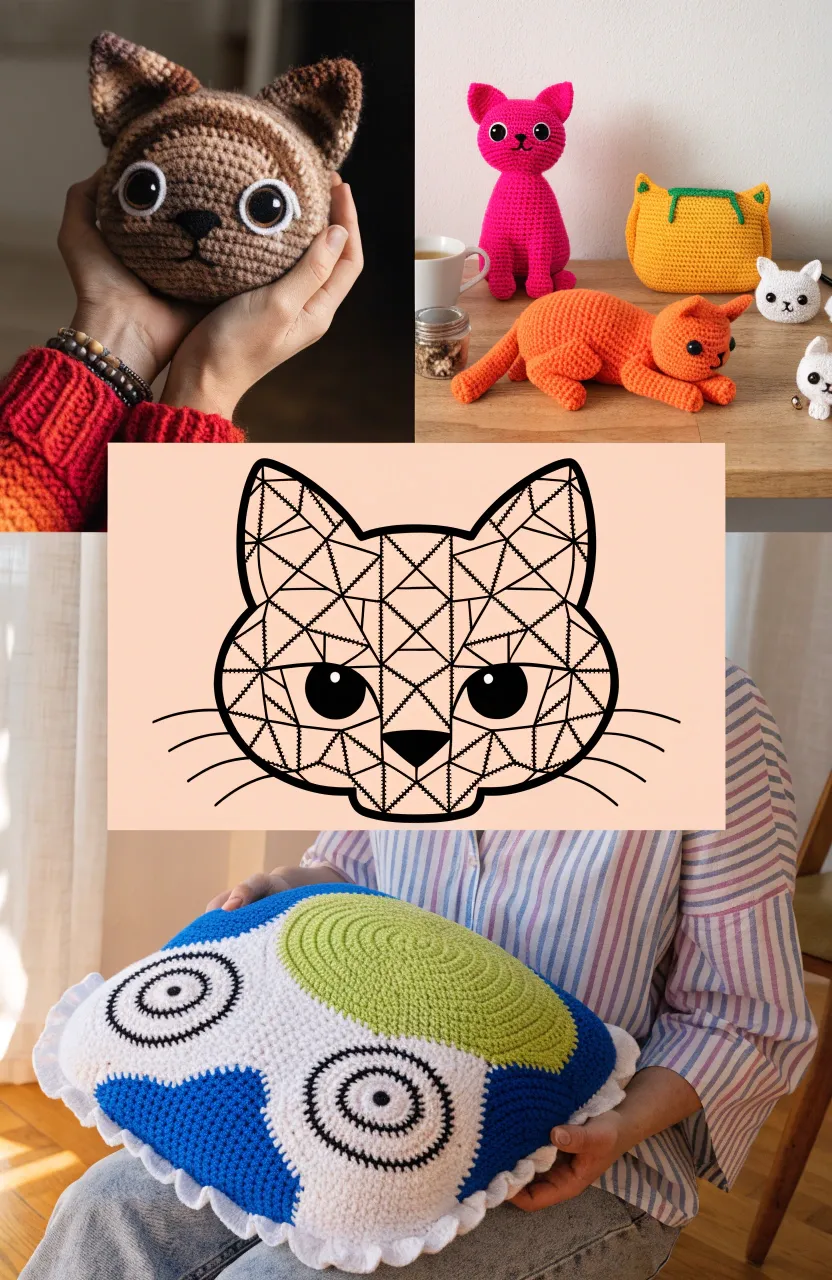
Crochet cat patterns range from small stuffed kitties and cat toys to wearable sweaters and home accents, with options for beginners and experienced makers alike. Their size, yarn choice, and construction shape the finished result, so the same cat-themed idea can become a tiny keepsake or a substantial home project. Gauge means the number of stitches and rows worked within a stated measurement of fabric.
For free crochet, an easy crochet project, or a more detailed design, choose based on what you want to make and how you plan to use it. A handmade cat can be a gift, a display piece, something to wear, or a toy for a pet. The pattern’s instructions help you judge its techniques and materials before you begin, while the finished size helps you decide where it belongs.
Key Takeaways
- Choose a format that suits the person, pet, or space it is for.
- Compare finished measurements when fit or scale matters.
- Yarn weight and hook size can change a stuffed figure’s size.
- Check a pattern’s techniques before you commit to the project.
- For child-directed toys, safety obligations depend on intended use and sale.
Choose a project by its intended use and the techniques you want to practice.
Pick a Cat Crochet Project by Its End Use
Start with the project’s destination: a wearable, a home accent and a cat toy solve different needs. A cat-themed crochet project can become clothing, a display piece, or something a pet bats around. Start with use, since the right format depends on who will use the finished item and where it will go.
A project’s purpose narrows the choices faster than its cat design alone. Wearables include hats and scarves for people who want to wear the design. Home decor can include amigurumi and afghans for display or comfort at home. Cat-play projects include beds and toys for cats who use handmade items.
| Project type | Examples | Best suited to |
|---|---|---|
| Wearables | Hats and scarves | People who want to wear the design |
| Home decor | Amigurumi and afghans | Display or comfort at home |
| Cat-play projects | Beds and toys | Cats who use handmade items |
Collections also include stuffed figures, cat-themed afghans, and other crochet projects. A home accent can decorate a shelf without needing the same fit checks as a sweater. A bed or toy serves a different purpose from a keepsake made for display.
A pattern photo alone cannot confirm fit or finished scale.
Use these checks to narrow your choice:
- Where will the finished project be used?
- Who will use it: a person, a pet, or someone receiving a gift?
- How much shaping or assembly do you want to do?
Check the pattern’s stated finished measurements before choosing a project meant to fit or fill a specific space.
Crochet Cat Patterns for Wearable Projects
For a seamless beginner garment, the Kitty Pop Pullover offers a top-down construction, while the Crochet Cat Sweater is designed around a small Sphynx cat. Fit matters because a wearable needs to match its intended body measurements, not just its pictured shape. Gauge is the stitch-and-row count within a stated measurement of fabric.
Compare each pattern’s size, gauge, and yarn requirements before beginning. A crochet cat sweater can be a rewarding cat crochet pattern, but the two designs serve different wearers. The Kitty Pop Pullover is sized XS-L for people, while the Crochet Cat Sweater is written for a particular small cat.
Kitty Pop Pullover
The beginner-level Kitty Pop Pullover is worked seamlessly from the top down in the round. It uses light-weight #3 yarn and a US G/6, 4 mm hook. A step-by-step video tutorial accompanies the pattern, which comes in sizes XS-L.
Its double crochet gauge is 8 stitches and 5 rows per 2 inches with a 4 mm hook. A second gauge option is 10 single crochet stitches and 10 rows per 2 inches, worked through the back loop with the same hook. The pattern calls for Mary Maxim Sunrise or Mary Maxim Lullaby light-weight #3 yarn. Yardage is 65, 95, 160, and 200 yards for sizes XS, S, M, and L, respectively.
Crochet Cat Sweater
The Crochet Cat Sweater is designed for a 7-pound Sphynx. It measures approximately 13 inches long by 13 inches around at its widest point. Its gauge is 8 double crochet stitches per 2 inches. Those measurements describe this design, not a universal cat size.
Try the sweater on as you make it and adjust the collar, shoulders, armholes, body, and cape for the individual cat. The pattern’s intended wearer and yarn requirements differ from the Kitty Pop Pullover, so do not transfer its sizing or supplies between projects. For either sweater, compare the cat’s measurements with the pattern’s intended fit before you start.
Small Amigurumi Cats for Quick Keepsakes
A tiny amigurumi can become a desk companion or a small handmade gift, and yarn weight can change its finished scale substantially. Small changes in materials can produce noticeably different versions of the same cat amigurumi. Smooth cotton and fuzzy chenille also offer different levels of stitch visibility.
Compare each finished size with its own yarn-and-hook combination. Two cat amigurumi projects may both look small in a photo yet differ in height, texture, and detail. Choose the combination that suits the use you have in mind.
Tiny Free Cat Amigurumi
The Tiny Free Cat Amigurumi can measure about 5 cm, or 2 inches, tall with sport-weight cotton yarn and a 2.5 mm hook. With super-bulky chenille yarn and a 5.0 mm hook, it can reach about 10 cm, or 4 inches. These are separate material combinations, not interchangeable estimates for one fixed size.
Sport-weight cotton creates a smaller, more defined figure. Chenille produces a larger, plush-looking kitty, though the fuzzy surface can hide individual stitches. That difference can make it harder to see where to place the hook, especially when you are still learning the pattern.
Molly the Cat
Molly the Cat was first published in April 2026 and last updated on October 27, 2026. With sport-weight cotton yarn and a 2.5 mm hook, the design can make a cat about 4 inches, or 11 cm, tall. Bulky chenille yarn and a 4 mm hook can make a cat about 6 inches, or 14 cm, tall.
Those finished measurements belong to Molly’s combinations and should not be treated as the Tiny Free Cat’s scale. Smooth cotton makes stitch definition easier to follow, while chenille gives the finished cat a softer, bulkier surface. If you are new to amigurumi, clear stitch visibility can help you keep track of shaping.
AmiAmore Kitty Cat Amigurumi Bundle
The AmiAmore Kitty Cat Amigurumi Bundle uses worsted-weight category 4 yarn and is rated beginner to intermediate. That rating suggests a step up from the simplest project, so read the pattern’s techniques before choosing it. A cat pattern can be a personal gift when its size, look, and making time suit the recipient.
Fuzzy chenille can make individual stitches harder to see than smooth cotton, so choose it for texture only if you can comfortably follow the fabric. Choose the yarn combination that gives you a size you can use and details you can comfortably work.
Larger Crochet Cats for Display and Cuddling
The Long-Legged Cat offers two stated finished heights, while Cat Squish is the option to consider when you want a large cat-shaped pillow. Scale changes the project’s role: one design has a lanky stuffed shape, and the other works as decor and a cuddly pillow.
Different yarn and hook combinations change both height and fabric. A crochet cat meant for display may suit a different shape from one you plan to cuddle. The pattern’s stated measurements describe a result, but matching its height does not guarantee matching its proportions when you change yarn and hook.
Long-Legged Cat
The beginner-level Long-Legged Cat uses slip stitches and single crochet. With DK/light-worsted yarn and a 2.50 mm hook, it measures about 24 cm, or 9 1/2 inches. A worsted-weight yarn and 3.00 mm hook make a figure about 28 cm, or 11 inches, tall.
The DK/light-worsted version used about 40 g of cotton-acrylic yarn. The worsted-weight version used about 65 g of wool yarn. These amounts refer to different yarns and finished heights, so the larger version does not simply reflect a change in hook size.
For crocheted toys, the Long-Legged Cat pattern recommends a hook at least a size or two smaller than the yarn-label suggestion. The smaller hook helps create a tight fabric that does not show stuffing. Fabric density matters as much as the figure’s height when you want a neat stuffed finish.
Cat Squish
Cat Squish is a large amigurumi design described as both decor and a cuddly pillow. Its pillow-like form gives it a different presence from the Long-Legged Cat’s upright, lanky body. Choose it when you want a broad, soft cat shape to display or cuddle.
For a stuffed figure, check the fabric as you work and reduce the hook size if stuffing shows through.
Crochet Toys Cats Can Bat Around
For a small cat-play project, the fish is the shortest listed toy and the octopus is the longest. Shape is one way to choose a cat toy, since different cats may prefer different forms. The Off the Beaten Hook collection includes four small designs made with the same yarn and hook setup.
The four toys use DK/light-worsted cotton yarn and a 3.00 mm hook. You can stuff them with fiberfill or yarn scraps, and catnip is optional. The sizes below are finished lengths, so the collection offers several shapes without changing its shared supplies.
| Toy | Finished length | Shared yarn and hook |
|---|---|---|
| Fish | 2.25 inches | DK/light-worsted cotton, 3.00 mm |
| Mouse | 2.5 inches | DK/light-worsted cotton, 3.00 mm |
| Octopus | 3.5 inches | DK/light-worsted cotton, 3.00 mm |
| Jellyfish | 3 inches | DK/light-worsted cotton, 3.00 mm |
A separate no-sew cat toy pattern lists 4-weight yarn and a 3.50 mm, or E, hook. It also allows optional catnip in the stuffing. A no-sew construction can suit makers who prefer to avoid joining separate pieces.
Keep cat-play toys free of plastic eyes, buttons, and other detachable small parts. Those additions can come loose during play, so embroidered features avoid introducing such pieces. Cats may prefer different toy shapes, and one cat’s favorite may not interest another.
Remove a handmade toy if its stitches loosen or any part starts to come free.
A Basketweave Cat Blanket for Home Decor
The Basketweave Cat Blanket is a compact home accent measuring 22.5 inches wide by 20 inches high. Its finished format is a blanket, not a cat pillow, so choose it for a small textile accent rather than a stuffed decor piece.
The pattern calls for approximately 750 yards of light-weight yarn held two strands together. It is designed for a US size 7, 4.5 mm hook, and a US size H-8, 5 mm hook, or hooks needed to obtain gauge. Holding both strands together throughout the project is part of the setup.
The gauge is 14 stitches per 4 inches, or 10 cm, across in pattern while holding one strand of each yarn together. Exact gauge is not critical for this project. That does not remove the need to work with the two strands as directed, since the pattern’s texture and fabric depend on that arrangement.
Cat-themed home decor can take more than one form. A crochet cat pillow is a soft, shaped accent, while this cat blanket is a flat textile with a basketweave design. Their uses and construction differ, even when both bring a cat motif into a room.
Before starting, make sure you have enough yarn for two strands held together across the blanket. Check your available yarn before starting, since the pattern calls for approximately 750 yards held two strands together.
Free Crochet Cats in Different Styles
Choose a recognizable coat or character style first, then decide whether you want to follow its colors closely or make your own version. A clear visual idea can help you select a free crochet cat pattern that feels personal without changing its basic form.
Check the pattern’s stated variation before planning color changes. A free three-cat pattern offers tabby, Siamese, and calico versions. Other cat patterns focus on a named character or a distinct motif, so their visual details may call for a closer match to the design.
| Pattern | Recognizable style | A good fit for |
|---|---|---|
| Free three-cat pattern | Tabby, Siamese, and calico | Makers choosing among coat styles |
| Jiji the Black Cat Amigurumi | Black-cat design | A maker who wants a black cat |
| Pusheen with Ice Cream | Pusheen with an ice cream cone | A maker who wants a character motif |
The three-cat pattern gives you a choice among tabby, Siamese, and calico looks. Jiji the Black Cat Amigurumi centers on a black-cat design. Pusheen with Ice Cream pairs the character with an ice cream cone, making the motif part of the finished figure.
Color changes can personalize an amigurumi pattern, but a pattern may not include instructions for every variation you imagine. A detailed motif can also be less suited to your first colorwork project. Simple changes often take less planning than a design with many small color sections.
Use the pattern’s instructions to guide your color plan, rather than assuming every pictured detail is explained. Confirm that the pattern instructions match the variation you want to make before choosing your colors.
Yarn, Hooks, and Stuffing for a Neat Finish
Gather the yarn and tools listed by the pattern, then check that your stuffing and hook suit the fabric you want. Pattern instructions come first, since general material tips do not replace a specific yarn requirement or hook size.
Cotton and acrylic yarns can hold an amigurumi shape well. Recycled polyester fiberfill can be packed firmly, but not too tightly. Overstuffing can make a figure stiff and distort its shape, so add filling in small amounts as you work.
Keep these five basic supplies nearby:
- Yarn listed by the pattern
- A suitable crochet hook
- Recycled polyester fiberfill or the pattern’s recommended stuffing
- A tapestry needle
- Scissors
Some crocheters also use stitch markers to track rounds. A tapestry needle helps finish seams and weave in yarn ends, while sharp scissors make clean cuts. These common tools support a tidy result without changing the pattern’s construction.
Yarn weight, fiber, and hook size affect the fabric, but a general material suggestion should not override the pattern’s required yarn. A yarn that feels soft in a skein may create a different fabric once worked. Add fiberfill in small amounts so you can adjust the shape before closing the final opening.
Crochet Skills That Make Shaping Easier
A quick skills check before the first stitch can prevent a small shaping error from spreading through the project. Know the pattern’s techniques before you begin, especially when a cat’s head, body, or limbs are worked in separate stages.
Track the first stitch in a continuous spiral with a removable marker. Losing the start of a round can shift increases or decreases, changing the shape without an obvious error. A marker helps you keep the project’s shaping consistent.
These five technique groups appear in many cat projects:
- Starting with a magic circle and working in the round
- Basic stitches: chain, slip stitch, single crochet, and double crochet
- Increasing and decreasing stitches for shaping
- Changing colors while keeping the design orderly
- Seaming pieces and weaving in yarn ends
A stitch marker can identify the first stitch in a spiral and help track increases, decreases, or short rows. It gives you a fixed point to compare with the written instructions, especially when the fabric has no visible seam to mark each round.
Basic stitch knowledge supports most easy crochet projects, but shaping gives a cat its recognizable form. If a pattern has separate pieces, seaming and woven-in ends are part of the finish, not optional details. Place a removable stitch marker in the first stitch whenever the pattern is worked in a continuous spiral.
Safety Rules for Children’s Crochet Toys
A crochet toy sold for children in the United States must meet applicable federal toy-safety requirements, not just look securely made. Intended use matters: under U.S. guidance, a product reasonably foreseeable to be used by children under 12 is a children’s product.
Children’s toys must comply with CPSIA and the ASTM F963 toy safety standard. Most children’s products require third-party testing by a CPSC-accepted laboratory and a Children’s Product Certificate. Requirements depend on the product and its intended users, so a handmade keepsake for personal use is not the same situation as a toy sold for children.
A toy intended for a child under 3 must not have accessible small parts under foreseeable use and abuse. For toys graded 0+, embroidered or crocheted features are recommended instead of plastic safety eyes. Changing the eyes alone does not establish that a toy meets all applicable requirements.
A toy intended for ages 3 and older that contains small parts requires a choking-hazard warning on its packaging under 16 CFR 1500.19. That labeling rule is one part of the broader safety picture. Construction, testing, certification, and labeling all matter for products sold as children’s toys.
The distinction between personal use and sale is important. A handmade keepsake made for your own collection is different from a product offered as a child’s toy in the United States. A safety-eye swap may address one design feature, but it does not replace required testing or other obligations.
Before selling a child-directed toy, verify the applicable testing, certification and labeling requirements for that product.
Personalize the Cat’s Colors and Expression
A familiar coat color or one small design detail can turn a basic cat shape into a personal keepsake. Small choices can make it yours, while leaving the pattern’s main construction unchanged.
Keep added details simple enough to preserve the intended use. A small figure meant for display may support more decoration than one designed for regular handling. A fuzzy yarn can also shift the look of the coat without changing the pattern’s shaping.
Coat Colors and Markings
A solid-color body gives a clean, simple look. Contrasting paws create a small accent, while stripes can suggest markings across the head, back, or tail. Fuzzy yarn adds a soft surface and changes the cat’s visual texture.
Pick a color plan before you begin if the pattern changes colors during construction. Stripes placed at different heights can make two figures look distinct, even when they share the same basic shape. Keep the changes manageable if you want to follow the pattern without adding complex shaping.
Facial Details and Accessories
Facial details affect expression: a small change in eye placement or mouth shape can make a cat look curious, calm, or playful. Simple add-ons, such as a small scarf or bow, can suit a decorative figure or handmade gift.
Try one of these four customization ideas:
- Make the body a single solid color.
- Use contrasting yarn for the paws.
- Place stripes along the back or tail.
- Add one small accessory, such as a scarf.
An accessory can change a small figure’s balance or its intended use. A hanging piece or extra decoration may catch on nearby objects, so consider how the finished cat will be handled or displayed.
Keep the pattern’s shaping intact and use color or a light accessory to make the design your own.
Conclusion
The best handmade cat project is the one that fits both its intended use and the skills you want to practice. A pattern’s finished size and construction matter as much as its appearance, especially when the result needs to fit a person or a particular place.
Choose one design and read its materials and instructions before you begin. Pick your pattern, read the full instructions and gather the listed materials before making the first stitch.
FAQ
Can I use a different yarn weight than a pattern lists?
Yes, but changing yarn weight can change both the finished scale and the fabric. A heavier yarn often creates a larger, thicker result, while a lighter yarn can make it smaller. Check gauge especially for fitted garments and projects with set measurements. You may also need a different hook to create a fabric that suits the pattern.
Do I need to make a gauge swatch for every crochet cat project?
No, a gauge swatch matters most for fitted sweaters and projects with target measurements. A decorative stuffed toy may prioritize a tight fabric over exact dimensions, since a dense fabric helps keep stuffing hidden. Follow the pattern’s instructions, and use a swatch when size or fit affects how the finished piece will work.
Can I make a crochet cat from leftover yarn?
Yes, small stuffed figures can make useful stash projects. Check that you have enough yarn for every color, including any contrasting details, and that the scraps match the pattern’s yarn weight. A different weight can change the finished size and fabric, so leftover yarn works best when it is close to the pattern’s listed materials.
How can I make a stuffed crochet cat stand upright?
Choose a pattern designed for a stable pose and distribute stuffing evenly through the body and limbs. A seated design is often easier to support than a narrow-legged one because its shape provides a broader base. The pattern’s intended pose matters, so adding more stuffing alone may not make a figure stand securely.
How should I wash a stuffed crochet cat?
Follow the care instructions for the yarn and any attached features. Handwashing and reshaping the figure to dry can be gentler when the yarn label allows it. Avoid assuming that every stuffed toy can go in a washing machine, since fiber, stuffing, and attached details may respond differently to water and agitation.
Can I sell finished items made from a crochet pattern?
Check the designer’s terms for that specific pattern before selling finished items. Permission to sell an object made from a pattern is separate from permission to copy, share, or redistribute its instructions. Keep any required credit or usage limits in mind, and do not assume that one designer’s terms apply to another pattern.