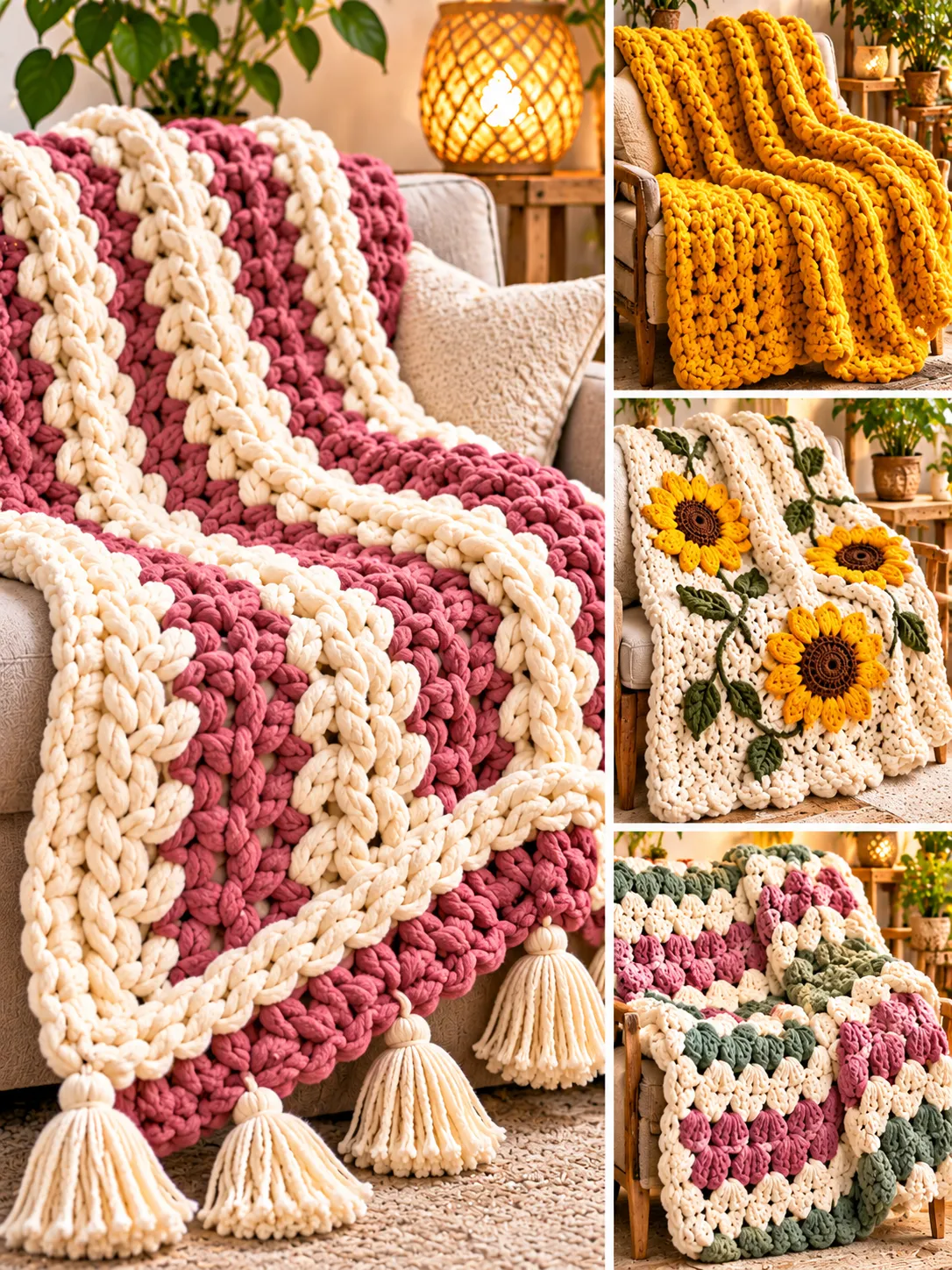
A chunky crochet blanket is the fastest way to make a room feel warm. The thick stitches look plush, the texture catches the light, and the whole thing works up in a fraction of the time a regular blanket takes. Many of these projects can be finished in a weekend or two, which makes them ideal for beginners, gift makers, and anyone who wants quick results.
This guide gives you six chunky blanket ideas with full pattern instructions: the simple chunky throw, the moss stitch blanket, the chunky ripple, the basketweave blanket, the giant granny square blanket, and the cable-look blanket made with post stitches. You’ll also find yarn advice, size charts, hook sizes, color ideas, troubleshooting, and care tips. Read it through once before you start.
What Makes a Chunky Blanket Different?
- Thick yarn. Super bulky (weight 6) or jumbo (weight 7) yarn creates big, soft stitches.
- Large hooks. You’ll use 10 to 25 mm hooks, or even your arms for arm crochet.
- Speed. A throw can take 6 to 15 hours instead of 30 or more.
- Simple stitches. Bold texture means you don’t need a complicated pattern.
- Weight. Chunky blankets are heavy and warm, which is part of the appeal.
- Cost. Chunky yarn is expensive per gram, so plan your budget.
The Projects at a Glance
| Blanket | Skill level | Time (estimate) | Best for |
|---|---|---|---|
| Simple chunky throw | Beginner | 6-10 hrs | First chunky project |
| Moss stitch blanket | Beginner | 8-14 hrs | Subtle texture |
| Chunky ripple | Beginner+ | 8-12 hrs | Couch throw, waves |
| Basketweave | Beginner+ | 10-16 hrs | Woven look |
| Giant granny square | Beginner | 6-10 hrs | Bold, graphic style |
| Cable-look blanket | Intermediate | 12-18 hrs | Statement piece |
Times are rough estimates and depend on your yarn, hook, and speed.
Materials and Tools
Yarn
For a chunky blanket, choose from these options:
- Super bulky acrylic or polyester (weight 6): affordable, soft, machine washable. A good first choice.
- Jumbo chenille (weight 7): very plush and velvety, but it can snag and sheds.
- Wool or wool blend roving: warm and natural, but pricey and needs gentle care.
- Cotton chunky tape yarn: firm and breathable, good for warm homes.
- Blanket yarn (polyester, thick strips): very easy to work and fluffy, a favorite for beginners.
Buy all of one color from the same dye lot. Large blankets show color differences.
Estimated Yarn Amounts
Chunky blankets use a lot of yarn. Amounts depend heavily on brand, thickness, and stitch.
| Size | Dimensions | Yarn needed (approx.) |
|---|---|---|
| Baby / pet | 70 x 90 cm | 600-900 g |
| Lap throw | 100 x 130 cm | 1,200-1,800 g |
| Couch throw | 125 x 150 cm | 1,800-2,500 g |
| Large throw / small bed | 150 x 180 cm | 2,800-3,800 g |
Always check the label for meterage, then compare it with your swatch. These figures are estimates.
Hook
Match the hook to the yarn:
| Yarn weight | Hook size |
|---|---|
| Super bulky (6) | 9 to 12 mm |
| Jumbo (7) | 12 to 20 mm |
| Thick roving | 20 to 25 mm |
If the fabric feels too tight, go up a size. If it looks too holey, go down.
Other Supplies
- Large yarn needle (or a crochet hook to weave ends)
- Scissors
- Stitch markers
- Measuring tape
- Optional: blocking mats, clips
Abbreviations (US Terms)
| Abbreviation | Meaning |
|---|---|
| ch | chain |
| sl st | slip stitch |
| sc | single crochet |
| hdc | half double crochet |
| dc | double crochet |
| FPdc | front post double crochet |
| BPdc | back post double crochet |
| sp | space |
| st(s) | stitch(es) |
| * * | repeat the instructions between asterisks |
| [ ] | stitch count at the end of the row |
Gauge: Don’t Skip It
Chunky yarn is expensive, so a swatch saves money. Crochet a swatch of at least 15 x 15 cm and measure the stitches and rows across 10 cm. Then calculate how many chains you need for your target width. For example, if 7 stitches make 10 cm and you want a 100 cm throw, you need about 70 stitches.
Project 1: The Simple Chunky Throw
The easiest chunky blanket. One stitch, one repeat.
Material: Super bulky yarn, 12 mm hook. Size: about 100 x 130 cm.
- Foundation: Ch 71 (about 100 cm, adjust to your swatch).
- Row 1: Hdc in the 3rd ch from the hook and in each ch across [69].
- Row 2: Ch 2 (does not count as a stitch), turn, hdc in each st across [69].
- Row 3 onward: Repeat Row 2 until the blanket is 130 cm long.
Fasten off, weave in ends with a large needle, and add a simple sc border if you like.
Tip: Place a stitch marker in the first stitch of every row. The most common mistake is skipping or doubling the last stitch.
Project 2: The Moss Stitch Blanket
The moss stitch (also called linen or granite stitch) makes a woven, textured fabric that is dense and warm without looking complicated.
Material: Super bulky yarn, 10 mm hook. Size: about 100 x 130 cm.
- Foundation: Ch an even number, about 64.
- Row 1: Sc in the 2nd ch from the hook, ch 1, skip 1 ch, sc in the next ch. Repeat across, ending with sc in the last ch.
- Row 2: Ch 1, turn, sc in the first st, sc in the ch-1 space, ch 1, skip the next sc. Repeat across, ending with sc in the last st.
- Row 3 onward: Repeat Row 2.
The fabric is narrower than a plain stitch, so measure often. Chain a bit wider than you think you need.
Project 3: The Chunky Ripple
A ripple blanket adds movement and looks great in two or three colors.
Pattern repeat: multiple of 12 plus 3. Example: 63 ch (for a medium throw).
- Row 1: Dc in the 4th ch from the hook, dc in the next 3 ch, dc3tog over the next 3 ch, dc in the next 3 ch, 3 dc in the next ch, dc in the next 3 ch. Repeat across, ending with 2 dc in the last ch.
- Row 2: Ch 3, turn, dc in the first st, dc in the next 4 sts, dc3tog, dc in the next 4 sts, 3 dc in the next st. Repeat across, ending with 2 dc in the top of the turning chain.
- Row 3 onward: Repeat Row 2, changing color every 2 rows.
Because chunky stitches are big, the waves are bold. Test the pattern on a swatch of about 8 rows before the full blanket and adjust the chain count so that peaks and valleys land at the edges.
Project 4: The Basketweave Blanket
Basketweave uses front and back post stitches to make blocks that look woven.
Pattern repeat: multiple of 8 plus 2 chains.
- Foundation: Ch 58 for a throw, adjust as needed.
- Row 1: Dc in the 4th ch from the hook and in each ch across [56].
- Row 2: Ch 3, turn, FPdc around the next 4 sts, BPdc around the next 4 sts. Repeat across, ending with 1 dc in the top of the turning chain.
- Row 3: Ch 3, turn, repeat the same pattern as the previous row’s stitches (FPdc over FPdc, BPdc over BPdc).
- Row 4: Same as Row 3.
- Rows 5 to 8: Switch the blocks: FPdc becomes BPdc and vice versa.
- Repeat Rows 2 to 8.
Post stitches draw the fabric in, so you’ll need a slightly wider foundation chain. Work a swatch of at least 10 rows to confirm the pattern before starting.
Project 5: The Giant Granny Square Blanket
A single enormous granny square, worked in chunky yarn, is the fastest way to make a statement blanket.
Material: Super bulky yarn in 4 or 5 colors, 12 mm hook.
- Round 1: Ch 4, join with a sl st to form a ring. Ch 3 (counts as dc), 2 dc into the ring, ch 2. 3 dc into the ring, ch 2. Repeat twice. Join.
- Round 2: Sl st to the corner. Ch 3, (2 dc, ch 2, 3 dc) in the same space, ch 1, (3 dc, ch 2, 3 dc) in the next corner. Repeat. Join.
- Round 3 onward: In each corner work (3 dc, ch 2, 3 dc). On each side, work 3 dc in every ch-1 space, with ch 1 between groups. Join.
Keep going until the square is about 100 to 130 cm across. Each round gets longer, so the work slows down. Change color every 1 to 2 rounds for a bold pattern.
Finish with 1 round of sc and a border. This is a great project for a travel or car-trip piece, because the work stays small at first.
Project 6: The Cable-Look Blanket
Real cables are complex, but post stitches can create a similar look.
Pattern repeat: multiple of 10 plus 4 chains.
- Foundation: Ch 54 for a throw.
- Row 1: Dc in the 4th ch from the hook and in each ch across [52].
- Row 2: Ch 3, turn, dc in the next 2 sts, FPdc around the next 6 sts, dc in the next 2 sts. Repeat across, ending with dc in the top of the turning chain.
- Row 3: Ch 3, turn, work stitches as they appear (dc on dc, FPdc on FPdc).
- Row 4: Same as Row 3.
- Row 5: Cross the cable: skip the first 3 FPdc, work FPdc around the next 3, then FPdc around the 3 skipped stitches in front. Continue across.
- Repeat Rows 2 to 5.
This pattern is a framework. Cables are fiddly and depend on yarn and hook, so test on a swatch and adjust stitch counts before starting the blanket.
Borders for Chunky Blankets
- Simple sc border: 1 or 2 rounds of sc, with 3 sc in each corner.
- Slip stitch border: a flat, neat edge for a modern look.
- Fringe: cut lengths of yarn, fold, and pull through the edge stitches. Looks boho but takes extra yarn.
- Reverse sc: a rope-like edge for extra structure.
Corners need 3 stitches in one stitch so the blanket lies flat.
Blocking Chunky Blankets
Blocking is optional with chunky yarn, but it helps with edges and ripples.
- Lay the blanket flat on towels or foam mats.
- Lightly mist with water, or follow the yarn label.
- Shape corners and edges.
- Dry completely, which can take a day or more because thick yarn holds moisture.
Never steam acrylic directly.
Color Ideas
- Soft neutral: cream, oatmeal, and light grey
- Warm earth: terracotta, mustard, and cream
- Cool calm: sage, dusty blue, and white
- Moody: charcoal, forest green, and burgundy
- Pastel nursery: blush, mint, and cream
- Monochrome: shades of a single color from light to dark
Tip: for a chunky blanket, solid colors show texture best. Multicolor or variegated yarn can hide the stitch pattern.
Styling Ideas
- Drape it over the end of a bed for a layered look.
- Fold it over the back of a sofa or armchair.
- Place it in a basket by the fireplace.
- Use it in a reading corner with pillows.
- Hang a smaller version on a ladder in the living room.
- Layer it with a lighter throw for contrast.
Troubleshooting
The edges are uneven.
Count the stitches at the end of each row, and mark the first and last stitch.
The blanket is getting narrower.
You’re missing the last stitch of each row. Use a stitch marker.
The fabric is too loose and holey.
Go down a hook size or switch to a denser stitch.
The fabric is too stiff.
Go up a hook size, or choose a softer yarn.
The yarn splits or tangles.
Pull the yarn from the center of the ball, and keep your hook smooth.
The blanket is too heavy.
Use a lighter yarn or a shorter blanket.
The blanket sheds.
Chenille and some polyester yarns shed. Wash it once, and remember this when choosing yarn.
The seams or ends come loose.
Weave ends in several directions with a big needle, and tie secure knots when needed.
Tips for Beautiful Results
- Swatch first. Chunky yarn is expensive.
- Use the right hook. A too-small hook gives a stiff, heavy fabric.
- Don’t pull too tight. Chunky yarn needs loose, relaxed tension.
- Keep the yarn at an even pace. Large stitches show mistakes more.
- Weave in ends carefully. Thick ends are bulky, so work them diagonally.
- Take breaks. Large hooks and heavy yarn can strain your hands and wrists.
- Block gently. Avoid stretching chunky yarn too much.
Care Instructions
- Check the yarn label before washing.
- Machine washable acrylic: wash on gentle in cool water, in a large laundry bag.
- Chenille and blanket yarn: wash gently, and dry on low or air dry.
- Wool: hand wash with wool detergent, and lay flat.
- Drying: thick blankets dry slowly. Lay flat on towels and flip it occasionally.
- Storage: fold and store in a breathable cotton bag, away from direct sunlight.
Safety Note for Baby and Pet Blankets
- Chunky stitches have large holes where small fingers and paws can get caught.
- Chenille and similar yarns can shed fibers.
- Follow safe sleep guidelines: no blankets in a baby’s sleep space.
- Use chunky blankets only for supervised play or cuddling.
Frequently Asked Questions
What is the easiest chunky blanket for a beginner?
The simple chunky throw in half double crochet. It uses one stitch and one repeat.
How long does a chunky blanket take?
Between 6 and 18 hours, depending on size and pattern.
What hook size should I use for chunky yarn?
9 to 12 mm for super bulky, and larger for jumbo yarn.
How much yarn do I need?
For a lap throw, about 1,200 to 1,800 g. Always swatch and check the label.
Is chunky yarn warm?
Yes. The thick fabric traps air, but warmth depends on the fiber. Wool is warmest, and acrylic is also warm but less breathable.
Can I wash a chunky blanket at home?
Many are machine washable. Check the label and use a large machine or laundromat.
Why is my chunky blanket heavy?
Thick yarn is dense. Use a lighter fiber or a more open stitch.
Can I use arm crochet?
Yes, for jumbo yarn it works well, but a large hook is easier to control for beginners.
Can I sell blankets made from these patterns?
Check the terms of the pattern source. If you write your own version, you decide.
Final Thoughts
A chunky crochet blanket gives you big results with little effort. Start with the simple throw, move on to moss stitch or ripple, and try the basketweave or cable-look blanket when you want a challenge. Pick a calm color, keep your tension relaxed, and enjoy how quickly the project grows. Share your finished blanket and tag us so we can see your version.