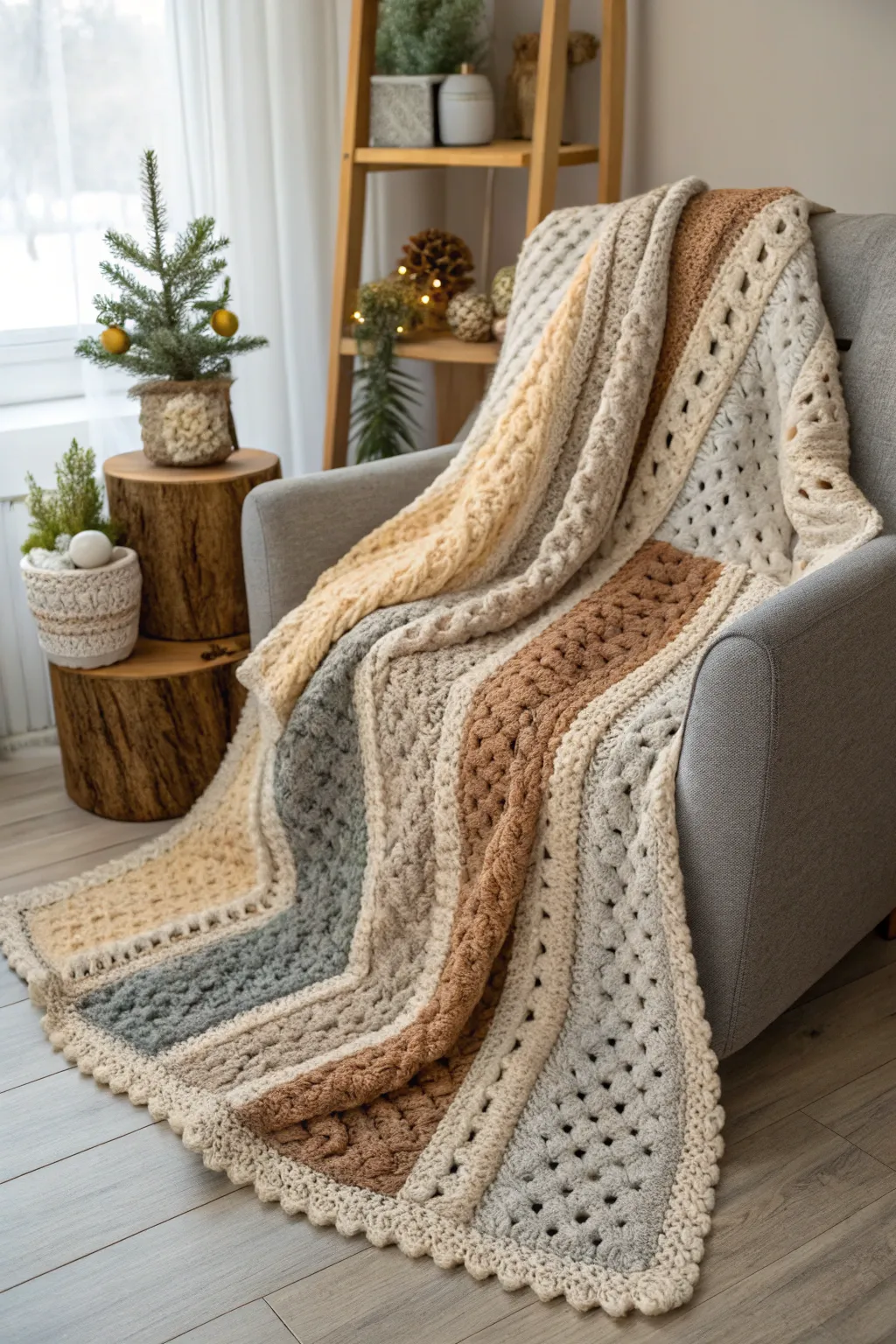
When the days get short and the evenings get cold, nothing beats a handmade blanket. A winter crochet blanket is thick, warm, and heavy in the best way. It turns a sofa into a nest, a bed into a refuge, and a cup of tea into an event. Winter is also the perfect season to crochet, because the project sits on your lap and keeps you warm while you work.
This guide gives you six winter blanket ideas with full pattern instructions: the cozy double crochet throw, the textured bobble blanket, the cable-look afghan, the thick-and-quick moss stitch blanket, the winter stripe blanket in snowy colors, and the Nordic-style blanket with a simple snowflake band. You’ll also find advice on choosing warm yarn, how fibers compare, size charts, color palettes, borders, troubleshooting, and care instructions. Read it through once before you start.
What Makes a Blanket Truly Warm?
- Fiber. Wool and wool blends trap heat best. Acrylic is warm and affordable. Cotton is breathable and cooler.
- Stitch density. Tight, textured stitches such as moss, bobble, and post stitches hold more air than open lace.
- Thickness. Heavier yarn and a smaller hook give a denser fabric.
- Weight. A heavier blanket feels cozier, but it should still be comfortable to lift.
- Size. A blanket large enough to tuck around your feet and shoulders feels warmer.
- Lining or layering. A fleece backing or a second thin blanket under it adds warmth.
The Projects at a Glance
| Blanket | Skill level | Time (estimate) | Best for |
|---|---|---|---|
| Cozy double crochet throw | Beginner | 20-30 hrs | First winter blanket |
| Bobble blanket | Intermediate | 30-45 hrs | Texture lovers |
| Cable-look afghan | Intermediate | 35-50 hrs | Statement piece |
| Moss stitch blanket | Beginner | 25-40 hrs | Dense, warm fabric |
| Winter stripe blanket | Beginner | 20-35 hrs | Snowy color play |
| Nordic snowflake band | Intermediate | 35-50 hrs | Gift or heirloom |
Times are rough estimates and depend on yarn, hook, and speed.
Materials and Tools
Yarn
- Wool or superwash wool: warmest and most breathable. Superwash can go in the machine. Regular wool needs hand washing.
- Wool-acrylic blend: a good balance of warmth, softness, and easy care.
- Acrylic (worsted or bulky): affordable and washable, with a huge color range. Warm, but less breathable.
- Alpaca or mohair blends: very soft and warm, but expensive and delicate.
- Chenille: velvety and plush, but it can shed and snag.
Buy each color from the same dye lot. Winter blankets are large, and lot differences show.
If you or the recipient has sensitive skin or a wool allergy, choose a soft acrylic or a superwash blend and test a small swatch against the neck or arm first.
Estimated Yarn Amounts (worsted weight)
| Size | Dimensions | Yarn needed |
|---|---|---|
| Lap throw | 100 x 130 cm (40 x 50 in) | 800-1,100 g |
| Couch throw | 130 x 160 cm (50 x 63 in) | 1,200-1,700 g |
| Twin bed | 170 x 220 cm (67 x 87 in) | 2,000-2,600 g |
| Queen bed | 220 x 240 cm (87 x 94 in) | 3,000-3,800 g |
Textured stitches such as bobbles and cables use 20 to 40 percent more yarn than plain stitches. These are estimates, so always make a swatch and buy extra.
Hook
Use a 5 to 6 mm (H-8 to J-10) hook for worsted yarn. For a denser, warmer fabric, go down half a size. For bulky yarn, use 8 to 10 mm.
Other Supplies
- Yarn needle
- Scissors
- Stitch markers
- Measuring tape
- Blocking mats and pins (optional)
- Optional: fleece for lining
Abbreviations (US Terms)
| Abbreviation | Meaning |
|---|---|
| ch | chain |
| sl st | slip stitch |
| sc | single crochet |
| hdc | half double crochet |
| dc | double crochet |
| FPdc | front post double crochet |
| BPdc | back post double crochet |
| sp | space |
| st(s) | stitch(es) |
| * * | repeat the instructions between asterisks |
| [ ] | stitch count at the end of the row |
Gauge: The Step That Saves Your Winter
Make a swatch of at least 15 x 15 cm in your chosen stitch. Measure how many stitches and rows fit in 10 cm, and divide your target width by that figure to get your starting chain. Textured stitches pull in, so chain a little wider than your math suggests. Wash your swatch the way you will wash the blanket before measuring, because wool and acrylic can change size.
Project 1: The Cozy Double Crochet Throw
Simple, quick, and warm. The best place to start.
Material: Worsted wool blend, 5.5 mm hook. Size: about 100 x 130 cm.
- Foundation: Ch 142 (adjust to your swatch).
- Row 1: Dc in the 4th ch from the hook and in each ch across [140].
- Row 2: Ch 3 (counts as a dc), turn, dc in each st across, with the last dc in the top of the turning chain [140].
- Row 3 onward: Repeat Row 2 until the blanket is 130 cm long.
Finish with a border. Place a stitch marker in the first stitch of each row so you do not skip the turning chain.
Tip: For a warmer, denser fabric, use half double crochet in place of double crochet. It takes longer but traps more heat.
Project 2: The Textured Bobble Blanket
Bobbles are small, puffy stitches that give a blanket a rich, three-dimensional surface.
Pattern repeat: multiple of 4 plus 3 chains.
A bobble here means 4 dc worked into the same stitch, each stopped at the last yarn-over so 5 loops remain on the hook, then closed by pulling through all 5 loops.
- Foundation: Ch 111.
- Row 1: Dc in the 4th ch from the hook and in each ch across [109].
- Row 2 (right side): Ch 3, turn, dc in the next 2 sts, bobble in the next st, dc in the next 3 sts. Repeat across, ending with dc in the top of the turning chain.
- Row 3: Ch 3, turn, dc in each st across.
- Row 4: Ch 3, turn, dc in the next 4 sts, bobble in the next st, dc in the next 3 sts. Repeat across to the last 4 sts, then dc in each. This offsets the bobbles.
- Row 5: Ch 3, turn, dc in each st across.
- Repeat Rows 2 to 5.
Bobbles are easy to lose track of. Work a swatch of about 12 rows to confirm the offset before starting the blanket.
Project 3: The Cable-Look Afghan
True cables are advanced. This version uses post stitches to give a similar ribbed, braided look.
Pattern repeat: multiple of 10 plus 4 chains.
- Foundation: Ch 104.
- Row 1: Dc in the 4th ch from the hook and in each ch across [102].
- Row 2: Ch 3, turn, dc in the next 2 sts, FPdc around the next 6 sts, dc in the next 2 sts. Repeat across, ending with dc in the top of the turning chain.
- Rows 3 and 4: Ch 3, turn, work each stitch as it appears (dc on dc, FPdc on FPdc). Work the post stitches around the posts of the row below.
- Row 5 (cross): Ch 3, turn, dc in the next 2 sts, skip the next 3 posts, FPdc around the next 3 posts, then FPdc around the 3 skipped posts working in front, dc in the next 2 sts. Repeat across.
- Repeat Rows 2 to 5.
This is a framework. Crossing stitches depends on your yarn and hook, so test it on a swatch and adjust the counts before committing to the blanket.
Project 4: The Thick-and-Quick Moss Stitch Blanket
Moss stitch makes a woven-looking fabric that is dense, flat, and warm without much effort.
Material: Bulky yarn, 8 mm hook. Size: about 100 x 130 cm.
- Foundation: Ch an even number, about 90.
- Row 1: Sc in the 2nd ch from the hook, ch 1, skip 1 ch, sc in the next ch. Repeat across, ending with sc in the last ch.
- Row 2: Ch 1, turn, sc in the first st, sc in the ch-1 space, ch 1, skip the next sc. Repeat across, ending with sc in the last st.
- Row 3 onward: Repeat Row 2.
The edges can wander in moss stitch, so count your stitches at the end of every few rows.
Project 5: The Winter Stripe Blanket
A simple stripe blanket in snowy tones looks calm and elegant.
Material: Worsted yarn in 4 colors, 5.5 mm hook.
- Foundation: Ch an even number, about 140.
- Row 1: Hdc in the 3rd ch from the hook and in each ch across.
- Row 2: Ch 2 (does not count as a stitch), turn, hdc in each st across.
- Row 3 onward: Repeat Row 2, changing color as desired.
Winter Palettes
- Snowfall: white, light grey, silver, and soft blue
- Pine forest: deep green, cream, brown, and burgundy
- Cabin: charcoal, red, cream, and tan
- Frosted berry: cream, cranberry, dusty pink, and grey
Change colors every 4 to 6 rows, and carry the yarn up the side only for stripes of 2 rows or less.
Project 6: The Nordic Snowflake Band Blanket
A plain blanket with one band of snowflake motifs is easier than working color charts across the whole piece.
Use a simple tapestry crochet approach with two colors:
- Make a solid blanket in sc or hdc in your main color, in the size you want.
- For the band, work rows in the main color with a contrast color carried inside the stitches.
- Follow a free snowflake chart on graph paper, where each square is one stitch. Work the contrast color on the squares marked, and carry the unused color along the top of the previous row.
- Repeat the motif across the blanket in a strip of about 20 rows.
Because tapestry crochet depends on your chosen chart and tension, test a small swatch of 20 stitches and 20 rows before starting. Keep floats short and tension relaxed so the blanket does not pucker.
Borders for a Finished Look
- Simple sc border: 2 or 3 rounds of sc, with 3 sc in each corner.
- Reverse sc (crab stitch): a rope-like edge that adds structure.
- Shell border: skip 1 stitch, 5 dc in the next, skip 1, sl st, repeat.
- Ruffle border: 2 or 3 dc in each stitch for a soft frill.
- Fringe: cut lengths of yarn, fold, and pull through the edge stitches for a cabin feel.
Blocking
- Lay the blanket on towels or foam mats.
- Lightly mist or dampen it, following the yarn label.
- Shape corners and edges and pin them.
- Let it dry completely, which can take a day or two for thick wool.
Never steam acrylic directly.
Color Ideas for Winter
- Snowy neutrals: cream, oatmeal, light grey, white
- Cabin warm: rust, mustard, brown, cream
- Deep jewel: emerald, navy, plum, gold
- Holiday: red, forest green, cream
- Cool calm: dusty blue, grey, white
- Berry: cranberry, burgundy, blush
Tip: dark colors hide wear, but light colors feel brighter in dark months. A mix of both with a neutral border works well.
Styling Ideas
- Drape it over the back of a sofa or armchair.
- Fold it at the foot of the bed.
- Keep a basket of blankets by the fireplace.
- Layer a chunky throw over a lighter blanket.
- Pair it with cushions in the same palette.
- Use a smaller version as a lap blanket for a reading corner.
Troubleshooting
The blanket is getting narrower.
You are likely skipping the last stitch of each row. Use a stitch marker.
The edges are wavy.
Count your stitches regularly and keep tension even.
The fabric is too stiff.
Go up a hook size or use a softer yarn.
The fabric is too loose and holey.
Go down a hook size or switch to a denser stitch like hdc or moss.
The bobbles are uneven.
Keep tension consistent and always work them on the same side.
The blanket is too heavy.
Use a lighter fiber or reduce the size.
The wool is itchy.
Switch to a softer blend, or line the blanket with fleece.
The colors look uneven.
Check that skeins share a dye lot, and alternate skeins every few rows.
Tips for Cozy Results
- Swatch and wash it. Fiber changes after washing.
- Choose yarn for skin comfort. A blanket is touched constantly.
- Count stitches regularly. Small mistakes become big ones.
- Weave in ends as you go. A pile at the end is demoralizing.
- Take breaks. Heavy blankets strain hands and shoulders.
- Add a border. It frames and stabilizes the blanket.
- Block gently. Avoid over-stretching textured stitches.
Care Instructions
- Check the yarn label before washing.
- Superwash wool and acrylic: machine wash on gentle in cool water, in a large laundry bag.
- Regular wool: hand wash with wool detergent and lay flat.
- Chenille: wash gently and dry on low or air dry.
- Drying: thick blankets dry slowly. Lay flat on towels and turn occasionally.
- Storage: fold and keep in a breathable cotton bag, with cedar for wool.
Safety Notes
- Heat sources: keep blankets away from heaters, fireplaces, and open flames. Yarn is flammable, and acrylic melts.
- Electric blankets or heating pads: do not layer a crochet blanket over them unless the manufacturer allows it.
- Babies and young children: do not place blankets in a baby’s sleep space. Use them only for supervised play or cuddling.
- Loose stitches: open textures can catch small fingers and toes.
Frequently Asked Questions
What is the warmest crochet blanket stitch?
Dense stitches such as moss, half double crochet, and textured post stitches trap more heat than open patterns.
What yarn is best for a winter blanket?
Wool or a wool blend is warmest. Soft acrylic is a good, washable alternative.
How long does a winter blanket take?
Between 20 and 50 hours, depending on size and pattern.
How much yarn do I need?
For a lap throw, about 800 to 1,100 g. Textured stitches use more. Always swatch.
What hook size should I use?
5 to 6 mm for worsted yarn, and 8 to 10 mm for bulky.
Can I wash a wool crochet blanket?
Superwash wool can go in the machine. Regular wool needs hand washing. Check the label.
What is the easiest winter blanket for a beginner?
The cozy double crochet throw. It uses one stitch and a single row repeat.
Can I sell blankets made from these patterns?
Check the terms of the pattern source. If you write your own version, you decide.
Final Thoughts
A winter crochet blanket is more than a project. It is something you work on through the cold months and then enjoy for years. Start with the double crochet throw or the stripe blanket, try moss stitch or bobbles when you want texture, and save the cable-look and Nordic designs for when you feel ready. Choose a yarn that feels good on your skin, keep your tension relaxed, and enjoy every row. Share your finished blanket and tag us so we can see your version.