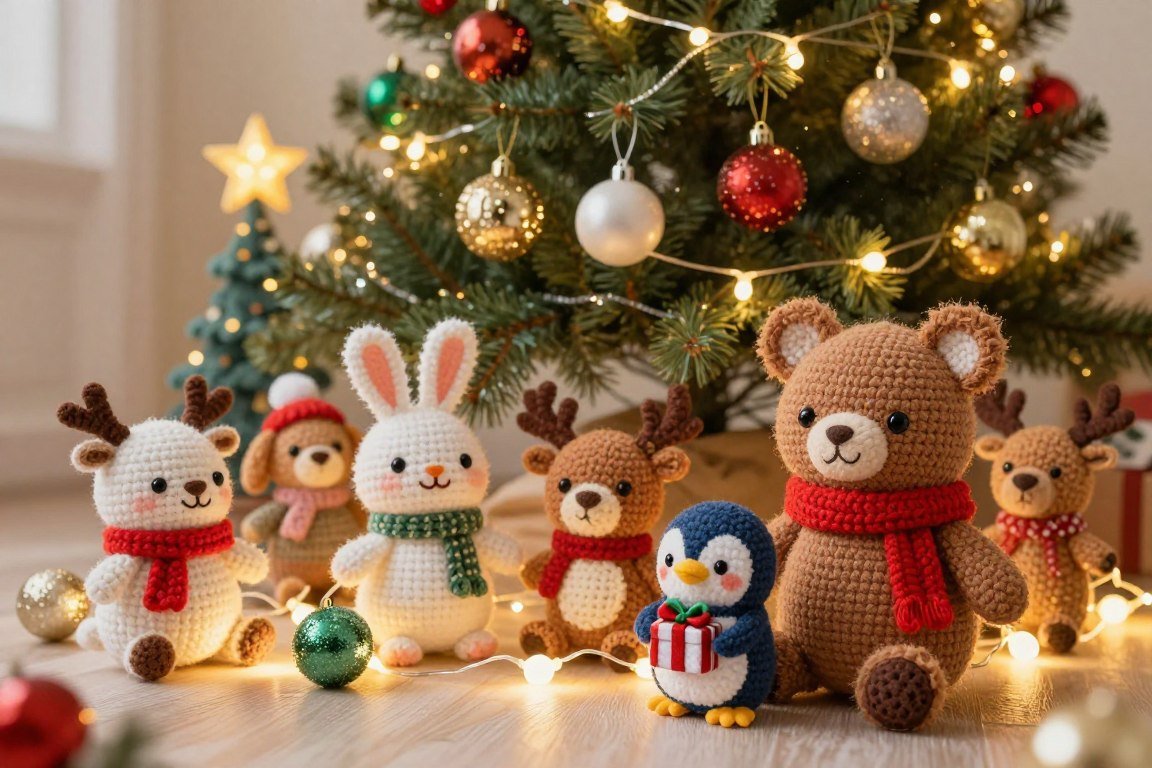
The Most Adorable Christmas Amigurumi Animals include snowmen, deer, bears, and gingerbread characters for holiday gifts or decorations. These designs suit different seasonal crafting plans, from small keepsakes to plush figures for a winter display. Not every pattern is free or designed for beginners, so compare the project details before you start. You can use the ten picks to narrow your choices without treating every cute design as the right fit.
What Christmas Amigurumi Can You Make?
A crocheter can make everything from a stuffed reindeer to a tiny holiday doll or tree decoration. Amigurumi is a crocheted or knitted three-dimensional figure, usually stuffed. Christmas crochet patterns may feature animals, dolls, trees, and familiar seasonal characters such as Santa Claus, angels, snowmen, and reindeer.
A flat crochet motif is not a stuffed three-dimensional figure. That difference helps you tell amigurumi patterns from flat shapes that can also decorate a home. A star worked in rows, for instance, may be a festive motif, while a stuffed star with joined sides is a small figure.
A flat motif is not amigurumi unless it becomes a stuffed, three-dimensional figure.
Holiday dolls and animals can be made as standalone figures, while small tree decorations can be shaped as miniature characters. You may also find patterns for Christmas trees, angels, and other figures with no animal features. Their construction can range from simple shapes to projects with several joined parts.
Think about the kind of figure you want to crochet before narrowing your search. A character pattern, an animal design, and a small decorative figure can all suit Christmas crochet, but they create different finished projects. Decide whether you want a character, an animal, or a small decorative figure before browsing patterns.
Quick Projects for Short Crafting Sessions
If you have only a short crafting window, a little chenille snowman is a practical winter project to consider. A free little chenille snowman crochet pattern is presented as a quick winter project. “Quick” describes how a pattern is positioned, not a guaranteed finish time for every crocheter. Your pace and the pattern’s construction still matter.
Christmas crochet collections can include quick ornaments as well as larger, more involved projects. A tiny ornament may need fewer parts than a set of figures, while a Nativity set can involve several characters and repeated construction. Use these three options to think about the effort you want to take on:
- A small chenille snowman offers a compact project to consider for a brief session.
- A simple ornament can be a small-scale option within a Christmas crochet collection.
- A multi-figure Nativity set represents a more involved project with several pieces.
Short sessions can still support steady progress if a pattern divides neatly into steps. Check whether the work includes multiple figures or separate pieces that need assembly. A small pattern is not automatically simple, and a larger project may have repeated shapes that are easy to track.
Before choosing a quick make, look at the number of parts and the techniques involved. A pattern description can signal a compact winter project, but it cannot predict how quickly you will crochet. Match the pattern’s complexity to the uninterrupted time you can actually set aside.
Choosing The Most Adorable Christmas Amigurumi Animals for Your Holiday Project
The collection’s six named designs offer a mix of familiar holiday characters and less expected animal choices. The Most Adorable Christmas Amigurumi Animals also include several deer and gingerbread variations that suit different tastes. Use each pattern’s stated materials and construction to judge how closely it fits your preferences.
A 2026 collection names a Christmas Dragon, Christmas Alpaca, Tumbling Snowmen, Cardinal, No-Sew Scrap Penguins, and Yule Log Dog. Other 2026 designs include a deer cupcake, a deer snuggle-toy, a one-piece deer, gingerbread characters, a plush moose, and Bax the Christmas Bear. These are ten picks, with three deer versions grouped together as one choice.
- A Christmas Dragon gives you a less traditional seasonal animal. Its pattern calls for medium-weight category 4 yarn.
- A Christmas Alpaca is another named animal design in the Christmas amigurumi pattern collection. Choose it if an alpaca fits the style you have in mind.
- Snowmen include the Tumbling Snowmen design and a separate little chenille snowman pattern described as a quick winter project. The two options give you different snowman patterns to compare.
- A Cardinal offers a bird design among the named collection picks. It is a distinct choice from the more common reindeer or snowman characters.
- No-Sew Scrap Penguins are included in the collection. The design’s name highlights both its penguin subject and its no-sew construction.
- Yule Log Dog pairs a dog character with a Christmas log theme. It is one of the collection’s named designs.
- Christmas Deer designs form one grouped pick: a free deer cupcake pattern, a free deer snuggle-toy with a security blanket, and a free no-sew deer worked in one piece. These variations differ in form and construction.
- Free amigurumi gingerbread patterns include a gingerbread man and a gingerbread lady. Both offer a character-based alternative to animal figures.
- A free Christmas moose pattern uses chunky plush yarn. That material is a stated feature of this particular design.
- Bax the Amigurumi Christmas Bear has a finished height of 7.5 inches. It is described as beginner-suitable and quick to make.
Some designs are animals, while others lean into familiar holiday characters. Among the reindeer options, the cupcake is a small character design, the snuggle-toy combines a stuffed figure with a security blanket, and the one-piece version avoids sewing. The gingerbread man and lady bring a different character style to the list.
Pattern names alone do not tell you everything about the work involved. Check the materials and construction details for the specific version you are considering. Compare the pattern’s stated materials and construction with what you already enjoy crocheting.
Where Can You Display or Gift Crochet Animals?
A tiny figure can brighten a tree, while a larger stuffed animal is better suited to a shelf or a gift. Small Christmas amigurumi can work as ornaments, and other designs can be displayed as decorative figures or given as soft toys. The intended use should shape the size and form you choose.
A hanging ornament needs a shape and construction that can support a loop and remain secure on a branch. A Christmas tree is a different setting from a shelf or mantel, where a figure can stand without hanging. A flat base or broader body may suit a shelf display better than a narrow hanging shape.
Soft toys can make handmade gifts for family or friends, while small figures can decorate a home. A cuddly design is not automatically suitable as a hanging ornament; its size and construction need to support that use. A larger figure may be too heavy or awkward for a tree branch, even if its appearance feels festive.
Think about where the piece will sit or hang before you choose a pattern. For a tree, consider the ornament’s scale and how it will attach. For a shelf, consider whether the figure can sit securely on its base. Check the intended display spot before choosing the pattern’s scale and shape.
Yarn Choices for Soft, Defined Stitches
Smooth, tightly spun worsted-weight yarn makes individual stitches easier to see while you learn. It can also provide structure for a stuffed toy. The pattern’s yarn requirements take priority over a general fiber preference.
Smooth worsted weight for beginners
Smooth worsted weight yarn is a useful choice for beginners because its stitches are easier to see and count. A tightly spun strand can give a stuffed figure a clear shape. That stitch definition can help you spot missed stitches before they affect later rounds.
Worsted weight is a yarn category, not a promise that every brand feels or behaves the same. Check the pattern’s listed yarn weight and fiber details. A textured or fuzzy strand can hide stitches, making it harder to follow a small amigurumi pattern.
Cotton for washable projects
Cotton yarn is washable and resistant to pilling over time, so it may suit projects that need repeated cleaning. That does not make cotton the best choice for every pattern. Its feel and structure differ from other fibers, and the pattern may call for a different yarn.
Consider cotton when washability matters to how you expect to use the finished figure. Keep the project’s construction in mind as well as the fiber. A pattern designed around a particular yarn may not hold the same look after a substitution.
Acrylic for easy-care projects
Acrylic yarn is washable, which can make it a practical option for an easy-care project. Its durability varies by brand, so the fiber name alone does not tell you how well a specific strand will wear. Check what the pattern calls for before switching.
The table compares the stated traits of these yarn choices. It is a starting point, not a reason to ignore the pattern’s materials list.
| Yarn | Stitch or care trait | Useful consideration |
|---|---|---|
| Smooth, tightly spun worsted weight | Clear stitch definition and structure | Beginner-friendly for stuffed toys |
| Cotton | Washable and resistant to pilling over time | Consider when repeated washing matters |
| Acrylic | Washable | Durability varies by brand |
One fiber will not suit every project, even when its care traits sound appealing. Check the pattern’s specified yarn weight before substituting a different fiber.
What Hook Size Works for Amigurumi?
For worsted, aran, or afghan yarn, start within the 2.75-3.75 mm range. For DK or light-worsted yarn, the guide range is 2.25-2.75 mm. Use the pattern’s instructions and your stitch tension to check the starting size.
Amigurumi often uses a snug fabric so stuffing does not show between stitches. A hook size that works for a scarf may not create the same tight fabric for a stuffed figure. The listed size is a starting point, while your own stitches affect the result.
The guide gives these ranges for common yarn categories:
| Yarn category | Hook-size range | Note |
|---|---|---|
| Worsted | 2.75-3.75 mm | Use the pattern’s gauge and stitch tension as a check |
| Aran | 2.75-3.75 mm | Use the same guide range |
| Afghan | 2.75-3.75 mm | Use the same guide range |
| DK | 2.25-2.75 mm | Use the same guide range |
| Light-worsted | 2.25-2.75 mm | Use the same guide range |
A small test swatch can show whether the fabric looks open before you begin the full toy. Follow the pattern’s hook guidance first, then check a few stitches with your selected yarn. Check a few stitches for visible gaps before committing to the full toy.
Stuffing Options for Different Finishes
Polyester fiberfill is a straightforward choice when you want a soft, traditionally stuffed toy. Cluster fiberfill is another toy-filling option, while rice and plastic bean-bag pellets can add weight. Add filling gradually to distribute it evenly through the shape.
Different stuffing choices create different finishes. Standard polyester fiberfill is a familiar option for general toy filling. Cluster fiberfill is also used to fill toys, while rice is listed as a weighted stuffing choice.
Plastic bean-bag pellets are an alternative to rice for weighted amigurumi stuffing. These materials have different roles, so choose based on whether you want a soft fill or added weight. The table summarizes those distinctions.
| Stuffing | Role | Practical distinction |
|---|---|---|
| Standard polyester fiberfill | General toy filling | Soft, familiar fill |
| Cluster fiberfill | Toy filling | A separate fiberfill option |
| Rice | Added weight | A listed weighted-stuffing option |
| Plastic bean-bag pellets | Added weight | An alternative to rice |
Even filling helps a figure hold its shape without creating one dense spot. Add small portions, then adjust them before the opening becomes difficult to reach. This approach gives you a chance to shape each section as you work.
A stuffed toy can feel firm or soft depending on the amount and placement of its filling. Press the outside gently as you shape it, and add more only where the form needs support. Add small amounts at a time so you can shape the toy before closing it.
Changing a Pattern’s Finished Size
To make a toy larger, pair heavier-weight yarn with a larger hook. To make it smaller, use thinner yarn with a smaller hook. Changing both yarn weight and hook size together is the basic way to shift a pattern’s finished size.
A heavier yarn and larger hook create larger stitches and a larger figure. A thinner yarn and smaller hook make a smaller result. Keep the pairing consistent rather than changing only one material and expecting the pattern’s listed dimensions.
A change in scale also changes how much stuffing the figure needs. Larger crochet projects generally use more stuffing than smaller versions. The pattern’s original filling amount may not suit a different-sized toy, so assess the shape as you work.
Size changes can affect proportions as well as overall height or width. The pattern may not shape identically when you change the yarn and hook, especially around small features or narrow parts. A larger version can also make details look different beside the body.
Try a small sample before adapting an entire project. Compare the fabric and proportions with the original design rather than assuming the finished shape will match. Make a small sample and compare its proportions before committing to a full-size change.
How Can You Make Crochet Toys Safer for Children?
For a toy intended for a child under 3, avoid any design that presents a small-parts choking, aspiration, or ingestion hazard. The CPSC bans children’s products intended for children under 3 when small parts create one of these hazards. Plastic safety eyes or noses can loosen or detach and become choking hazards.
Why plastic features need care
The CPSC defines a small part as an object that fits entirely into the small-parts cylinder without compression and in any orientation. That rule concerns whether a product presents a choking, aspiration, or ingestion hazard for children under 3. A plastic eye or nose may look firmly attached but can still loosen or come off.
Consider these three checks when choosing a toy design:
- Confirm the intended age for the finished toy.
- Check that attached parts are secure.
- Use embroidered features where appropriate.
Embroidered features for baby toys
Embroidered facial features avoid the separate plastic eyes and noses used in some patterns. They are recommended for toys intended for babies or children. Choose embroidered facial features for a toy intended for a baby or child.
Follow the pattern’s method for adding facial details, and consider whether each attached part can come loose. A toy’s appearance does not show how securely its features are fastened. Choose embroidered facial details for a toy intended for a baby or child.
What to Expect From a Beginner Crochet Kit
A beginner kit can reduce the guesswork by bundling a pattern with selected yarn and project-specific accessories. Kits may include a printed pattern, yarn, accessories, and sometimes a crochet hook. Contents vary, so check what the particular kit includes before you begin.
Common kit contents
A kit may supply materials selected for one project, rather than a broad set of tools for many projects. A hook is sometimes included, but not every kit has one. Project-specific accessories can also differ, so the kit’s contents list matters more than its beginner label.
Some kits include a pre-started piece, which gives you a prepared beginning. Others provide printed directions or an illustrated guide. These details can change how much setup you need to do before your first stitches.
Video and guided project formats
Video tutorials and QR video tutorials offer guided support in different kit formats. Here are four examples and their stated inclusions:
| Kit | Projects or guided support | Other stated inclusions |
|---|---|---|
| Woobles Pierre the Penguin | Video tutorials | Easy Peasy Yarn, pre-started piece, hook, safety eyes, stuffing, scissors |
| GOOKIE Capybara | Illustrated guide and QR video tutorial | Yarn, hook, safety eyes, stuffing, yarn needle |
| Joyclub | Six animal projects and video tutorials | 40% extra yarn |
| Mewaii | Three sea-turtle projects and a video tutorial | Pre-started piece, 40% extra yarn |
Hoooked kits use simple stitch patterns, chunky yarn, and step-by-step instructions. This is another format for guided projects, with a different approach to the materials and directions. Before choosing a kit, confirm that its included tools match what you need for the project.
Skills Behind Amigurumi Pattern Difficulty
A pattern’s difficulty depends on its construction as well as the stitches it names. Basic stitches and simple shapes can be approachable, while crocheting in the round, shaping, and assembly add complexity. Read the assembly steps as part of the difficulty check.
Crocheting in the round means working in a continuous or joined circular form, rather than only back and forth in rows. Shaping changes the outline as you add or reduce stitches. A pattern may use familiar stitches but still demand careful counting to form a rounded body or head.
Assembly can also take more attention than the crochet itself. Separate limbs, ears, or other parts may need to be placed and attached in a particular order. If you overlook those instructions, you may misjudge how much finishing the project requires.
Hardicraft kits are described as intermediate-to-advanced amigurumi kits that require crocheting in the round and shaping techniques. That description is an example of a particular skill set, not a recommendation. Look for the techniques named in a pattern and compare them with work you have already done.
Photos may show the finished figure without showing how many pieces create it. Check the pattern’s construction notes before deciding based only on the final image. Read the assembly instructions before deciding that a pattern is within your comfort zone.
Festive Colors and Details That Change the Look
Red, green, white, and gold give a familiar holiday palette that can be used in different proportions. Color choices can shift the feel of a crochet Christmas design without changing its basic form. A few deliberate color choices often read more clearly than many competing details.
Try one of these four approaches when planning colors for decorations or handmade gifts:
- Use classic red and green as the main colors.
- Pair white with gold accents for a lighter palette.
- Add a restrained candy-cane stripe to one part of the figure.
- Choose a personal palette that coordinates with the recipient’s decor.
Metallic thread held together with regular yarn can add subtle shimmer. Try it on a small detail rather than adding shine across every part. A tiny figure can become visually cluttered if too many colors, stripes, or embellishments compete for attention.
Color placement matters as much as the palette itself. A small stripe or accent can mark a feature, while broad color changes can alter the balance of the figure. Test a color combination with the actual yarn before making several matching decorations.
Finishing Handmade Gifts and Tree Ornaments
A small crocheted figure can serve as a tree ornament or a finishing touch on a wrapped gift. A stuffed animal design can also become a handmade gift for friends or family. Use a hanging loop only when the figure’s size and construction support it.
Small keepsakes and tree ornaments
Check that the hanging loop is secure before placing a small figure on a Christmas tree. The loop should pass through sturdy stitches, not a loose strand that can pull free. A small amigurumi can also sit on top of a wrapped gift as a reusable topper.
For a topper, attach the figure so it stays in place while the package is handled. Avoid placing a heavy piece where it can slide off or bend the wrapping. A small keepsake can make a package feel personal without needing elaborate decorations.
Soft gifts and presentation
A simple tag can carry the recipient’s name or a short holiday message. Modest presentation options include tissue paper, a small box, or a ribbon. Choose a format that protects the figure and suits the occasion, without making the wrapping part of the project.
Presentation is separate from whether a toy is suitable for a child. A name tag or ribbon does not change how securely facial features or other parts are attached. Secure any tag or hanging loop so it stays attached during handling.
Cleaning and Storing Finished Crochet Toys
Brush or spot-clean dust gently before putting a finished toy away. For a small mark, use a soft cloth with mild soap and cool water. Avoid soaking a stuffed piece, which can leave it misshapen or slow to dry.
Work on the mark gently rather than submerging the whole figure. Let the piece air-dry completely after cleaning. If the shape shifts while damp, reshape it carefully before it dries.
Store finished amigurumi in a cool, dry place away from direct sunlight. A zip bag or plastic storage box can protect pieces from dust and insects. Make sure the container is dry before you put the figure inside.
Keep delicate small pieces separate from larger toys so they do not get pressed or tangled. A separate pouch or a divided storage box can help keep small decorations together. Store the piece only after it is completely dry.
A Pre-Crochet Checklist for Choosing a Pattern
A quick materials and construction check can prevent a project from stalling halfway through. A pattern’s title or photo may not make its construction method obvious. Read the instructions before starting, including the finishing steps.
Use this four-point checklist before making your first stitches:
- Confirm the skill level and read the assembly steps.
- Gather the specified yarn and hook.
- Check whether you need a yarn needle or stitch marker.
- Set aside time for finishing the figure.
A yarn needle can help join parts or weave in ends, while a stitch marker can track a round’s start. Patterns may specify yarn, hook, construction, and finishing needs in different places. Scan the full set of instructions so a small tool or final step does not catch you by surprise.
A pattern photo may hide how the figure is built, so read the construction instructions before you begin.
Gather the listed supplies in one place and keep the pattern available while you work. This makes it easier to find a tool when a step calls for it. Set out the pattern, yarn, hook, and any finishing tools before making the first stitch.
Conclusion
The right Christmas amigurumi project is the one that suits both your plans and the person or space it is for. A handmade gift may call for a different design than a small seasonal decoration. Your available time and comfort with the construction also help determine which project makes sense.
Choose one pattern that feels manageable and useful for its intended recipient. Read its materials list before gathering supplies, then begin with the first clear step. Pick one pattern, gather its listed materials, and make a small start on your holiday crochet.