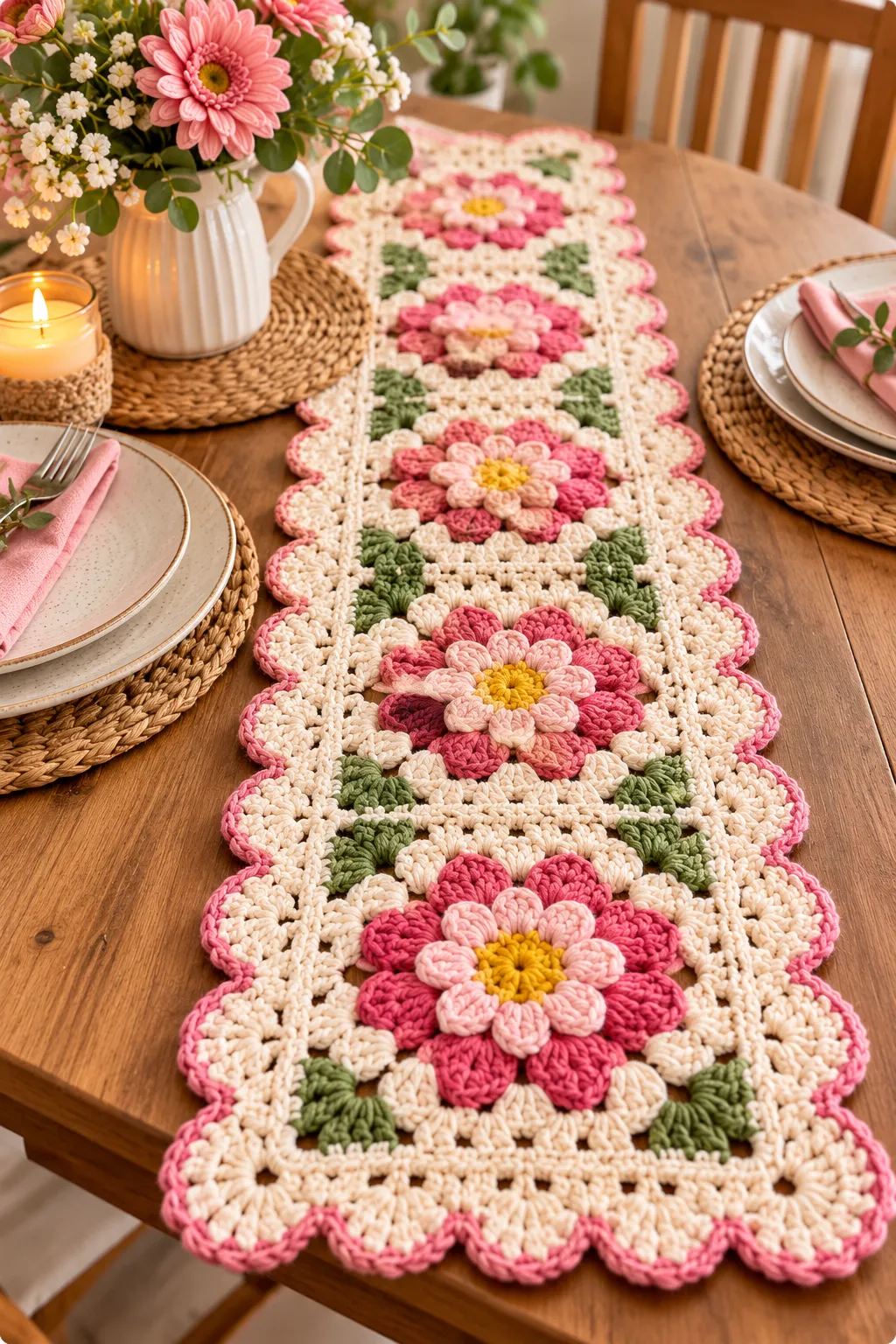
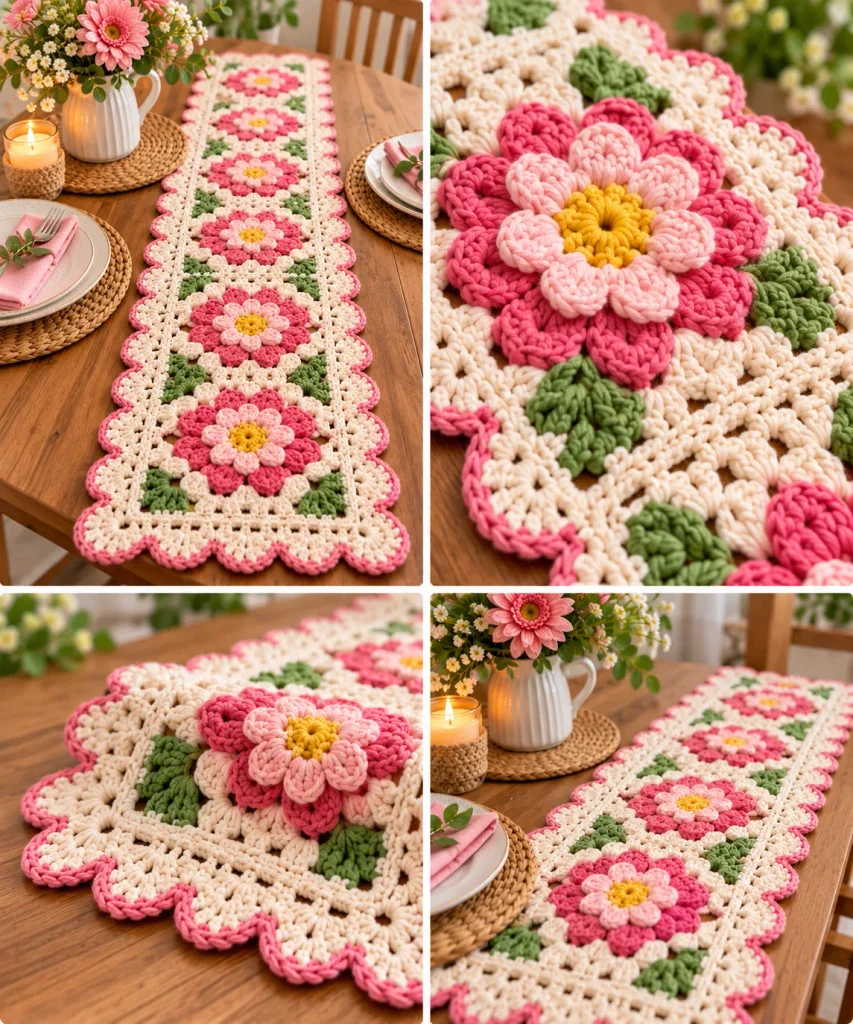
This title is close to the earlier table runner articles (flowers, cottagecore, sunflower, luxury lace, granny squares, diamond lace, Christmas ripple, shell stitch, and wheat stitch), so I chose a new design: a daisy chain runner made of small joined daisy motifs. Each daisy is worked in the round with white petals and a yellow center, then joined to its neighbors in the last round. It is easy to carry, easy to resize, and very photogenic. Use it on a dining table, a dresser, or a bedside table, or give it as a spring gift.
Pattern Information
Skill level: Beginner to intermediate, with joining as you go.
Terms: US crochet terminology.
Construction: Eleven daisy motifs are worked separately, joined to each other in the last round, then edged with a simple one-round border.
Estimated size: About 10 × 100 cm (4 × 39 in) after blocking. Each daisy measures about 9 cm across. Actual dimensions depend on yarn, tension, and blocking.
Pattern note: This is an original design based on the title concept. Stitch counts have been checked, but the pattern has not been physically crocheted or independently tested. Make one daisy first and adjust the hook size to reach 9 cm.
Materials
- DK-weight cotton yarn in white, approximately 90 g, for the petals and border.
- Yellow, approximately 15 g, for the centers.
- Sage green, approximately 20 g, for the joining round (optional, can use white).
- A 3 mm hook as a starting point (adjust to your tension).
- Tapestry needle, scissors, stitch markers, and pins.
- Blocking mats and a spray bottle.
Stitches and Abbreviations
| Abbreviation | Meaning |
|---|---|
| MR | magic ring |
| ch | chain |
| sl st | slip stitch |
| sc | single crochet |
| hdc | half double crochet |
| dc | double crochet |
| sp | space |
| st(s) | stitch(es) |
Work in joined rounds without turning. Ch 3 at the start of a round counts as a dc. Numbers in brackets give the stitch or space count at the end of each round.
Before You Begin
Make a single daisy and measure it. If it is smaller or larger than 9 cm, change the hook size by 0.25 to 0.5 mm. All daisies must be the same size for the runner to lie flat.
Lay the daisies in a straight row. Each daisy joins to its neighbor at one petal tip on each side, so mark those two petals (opposite each other) with stitch markers on every daisy.
Daisy Motif (make 11)
Round 1 (yellow): 12 sc in MR. Join with a sl st to the first sc. Fasten off. [12]
Round 2 (white): Join white in any stitch. Ch 1, 2 sc in the same stitch and in each stitch around. Join. [24]
Round 3 (petal bases): Ch 1, sc in the same st. Ch 3, skip 1 st, sc in the next st. Repeat around, ending with ch 3 and a sl st in the first sc. [12 ch-3 sps]
Round 4 (petals): Sl st into the first ch-3 sp. In each ch-3 sp work (sc, hdc, 3 dc, hdc, sc). Join and fasten off. [12 petals]
Round 5 (sage, joining round): Join sage in the center dc of any petal. Ch 1, sc in the same stitch. Ch 5, sc in the center dc of the next petal. Repeat around, ending with ch 5 and a sl st in the first sc. [12 ch-5 arches]
For Daisy 1: work Round 5 as written.
For Daisies 2 to 11: work Round 5 as written, except on the two marked arches. On the arch facing the previous daisy, work ch 2, sl st in the matching arch of the previous daisy, ch 2 instead of ch 5. Do this on one arch only per join.
Fasten off and weave in the ends.
Border
Round 1 (white): Join white at any arch. Ch 1, work 3 sc in each free ch-5 arch and 1 sc in each join point. Work 3 sc at each outer end of the runner. Join with a sl st to the first sc.
Round 2 (white): Ch 1, sc in each stitch around, working (sc, ch 2, sc) in the center stitch of each group of 3 sc to make small scallops. Join, fasten off, and weave in the ends.
Note: the exact border count depends on your tension. If the edge ripples, skip a stitch between scallops. If it pulls in, add one.
Finishing and Blocking
Soak the runner in cool water with a drop of mild soap and press out the water in a towel without wringing. Pin it flat on a blocking mat, opening each arch and shaping each petal. Let it dry completely before unpinning.
Practical Tips and Troubleshooting
The daisies are different sizes. Check your tension and block each one to 9 cm before joining.
The runner pulls into a curve. Your join chains are uneven. Always join on the two opposite arches and keep the join chains the same length.
The petals curl. Block firmly, or go up half a hook size for Round 4.
The runner is too short. Add daisies one at a time. Each daisy adds about 9 cm.
The border does not lie flat. Adjust on straight stretches, not at the arches.
FAQ
Can I use thread instead of yarn? Yes. Use size 10 cotton thread and a 1.75 mm hook. The daisies will be about 5 cm, so use 20 daisies for the same length.
Can I make it wider? Yes. Make a second row of daisies and join them side by side through their side arches before the border.
Can I use other colors? Absolutely. Try pale pink petals with a gold center, or a rainbow of petal colors.
Do I need to block it? It is strongly recommended. Blocking opens the arches and makes the petals lie flat.
More Free Crochet Patterns
- Crochet Table Runner Pattern (Delicate Flowers)
- Sunflower Crochet Table Runner Pattern
- Cottagecore Crochet Table Runner Pattern
Save This Pattern
Pin this Free Crochet Table Runner Pattern to your Pinterest board for your next spring project. Happy crocheting!