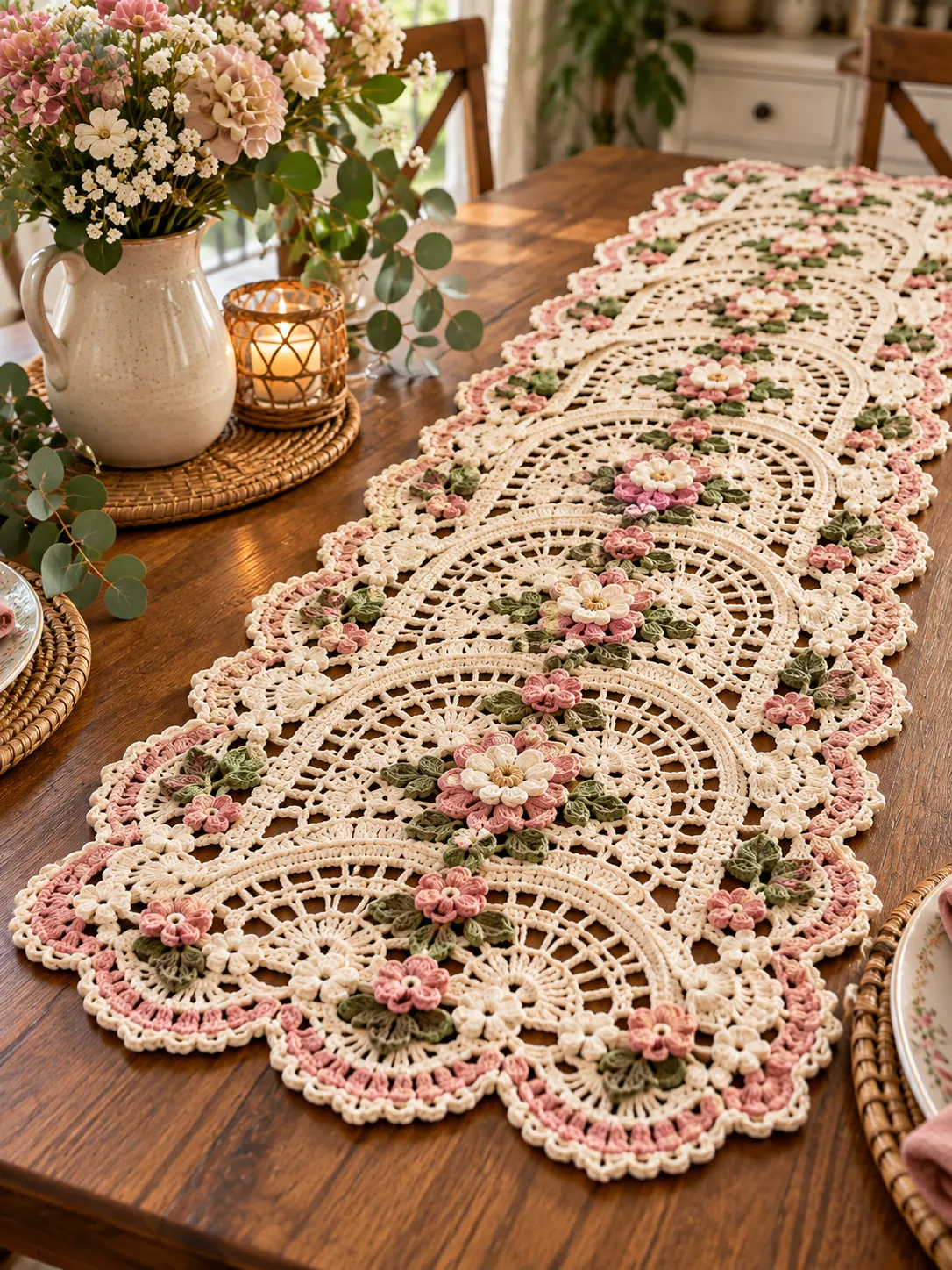
This Cottagecore Crochet Table Runner Pattern has a soft cream body of alternating lace-arch rows and solid rows, finished with a deep scalloped border and a trail of little hand-sewn daisies. It looks like something from a grandmother’s farmhouse kitchen. Use it on a wooden table, a bookshelf, or a dresser, or under a jar of wildflowers.
Pattern Information
Skill level: Advanced beginner to intermediate, with simple lace and edging.
Terms: US crochet terminology.
Construction: The body is worked flat from a long foundation chain, then edged with a scalloped border in joined rounds. Small daisies are made separately and sewn on.
Estimated size: About 20 × 100 cm (8 × 39 in) after blocking, including the scalloped edge. Actual dimensions depend on yarn, tension, and blocking.
Pattern note: This is an original design based on the title concept. Stitch counts have been checked, but the pattern has not been physically crocheted or independently tested. Check your gauge and adjust the foundation chain in multiples of 4 to change the length.
Materials
- DK-weight cotton yarn in cream or ecru, approximately 150–200 g as a starting allowance.
- White cotton yarn, about 15 g, and yellow cotton yarn, about 5 g, for the daisies.
- A 3.5 mm hook as a starting point (adjust to your tension).
- Tapestry needle, scissors, stitch markers, and pins.
- Blocking mats and a spray bottle.
Stitches and Abbreviations
| Abbreviation | Meaning |
|---|---|
| ch | chain |
| sl st | slip stitch |
| sc | single crochet |
| hdc | half double crochet |
| dc | double crochet |
| MR | magic ring |
| sp | space |
| picot | ch 3, sl st in the first ch |
| st(s) | stitch(es) |
The body is worked in turned rows. The edging is worked in joined rounds. Numbers in brackets give the stitch count at the end of each row or round.
Before You Begin
Work a small swatch of Rows 1–3 before you start the full runner. The arch rows should be airy but not floppy. If they look loose, go down a hook size. Cotton blocks very well, so a slightly uneven runner will straighten out at the end.
To change the length, begin with a foundation chain of 4k + 2, where k is the number of arches per arch row. The edging count will change with it, so recalculate Round 1 of the border (see the note after Round 1).
Runner Body
Ch 178.
Row 1 (solid): Sc in the 2nd ch from hook and in each ch across. Turn. [177 sc]
Row 2 (arches): Ch 1, sc in the first st. (Ch 3, skip 3 sts, sc in the next st) × 44. Turn. [45 sc, 44 ch-3 arches]
Row 3 (solid): Ch 1, sc in the first st. Work 3 sc in each ch-3 arch and 1 sc in each sc across. Turn. [177 sc]
Rows 4–27: Repeat Rows 2 and 3 (arch row on even rows, solid row on odd rows), ending with a solid row (Row 27). Do not fasten off. [13 arch rows, 14 solid rows]
Scalloped Edging
Round 1 (foundation round): Ch 1, do not turn. Work 3 sc in the corner, then sc evenly along the short end (one sc per row end, 27 sc). Work 3 sc in the next corner, then 1 sc in each foundation chain along the long edge (177 sc). Work 3 sc in the corner, 27 sc along the second short end, 3 sc in the final corner, and 177 sc along the top edge. Join with a sl st to the first sc. [420 sc: 354 along the long edges, 54 along the short edges, and 12 in the corners]
Note: If you change the runner length or row count, make sure the total in Round 1 is a multiple of 6. Add or skip one or two stitches along the edges to adjust.
Round 2 (scallops): Ch 1, sl st in the same st. Skip 2 sts, 5 dc in the next st, skip 2 sts, sl st in the next st. Repeat around. Join with a sl st to the first sl st. [70 scallops, 5 dc each]
Round 3 (picot trim, optional): Sl st across to the 3rd (center) dc of any scallop. (Sc, picot, sc) in the center dc, ch 3, sc in the sl st between scallops, ch 3. Repeat around. Join, fasten off, and weave in the ends. [70 picots]
Daisy Motif (make 7)
With yellow yarn:
Round 1: 10 sc in MR. Join with a sl st to the first sc and fasten off. [10 sc]
Round 2 (petals): Join white in any st. Ch 4, sc in the 2nd ch from hook, hdc in the next ch, dc in the last ch, sl st in the next st of Round 1. Repeat 10 times. Fasten off and weave in the ends. [10 petals]
Sew the daisies along the center line of the runner, spacing them about 12 cm apart, using small stitches through the yellow center. Add tiny green leaves in embroidery if you like.
Finishing and Blocking
Wash the runner gently in cool water with a drop of mild soap and press out the water in a towel without wringing. Pin it flat on a blocking mat, shaping each scallop and keeping the long edges straight. Let it dry completely before unpinning.
Practical Tips and Troubleshooting
The edges curl. Your tension may be too tight in the solid rows. Go up half a hook size or block more firmly.
The arches look uneven. Count the skipped stitches carefully. Always skip exactly 3 sts and work the sc in the 4th. A stitch marker at every 10th arch helps.
The scallops don’t lie flat. Check that Round 1 is a multiple of 6. If it isn’t, add or skip a stitch in a long-edge stretch rather than at the corners.
The runner is too narrow. Add rows in pairs (one arch row and one solid row) before the edging. Each extra pair adds 2 sc to each short edge.
FAQ
Can I use thicker yarn? Yes. Use a matching hook and expect a larger runner. A shorter foundation chain may be enough.
Can I skip the daisies? Yes. The lace and scalloped edge look lovely on their own.
Can I use color? Soft sage, butter yellow, or dusty pink all suit the cottagecore look. Try a contrast color for Round 3 of the edging.
Do I need to block it? It is strongly recommended. Blocking sets the scallops and evens out the arch rows.
More Free Crochet Patterns
- Crochet Lace Doily Pattern
- Vintage Flower Coaster Set
- Granny Square Table Topper