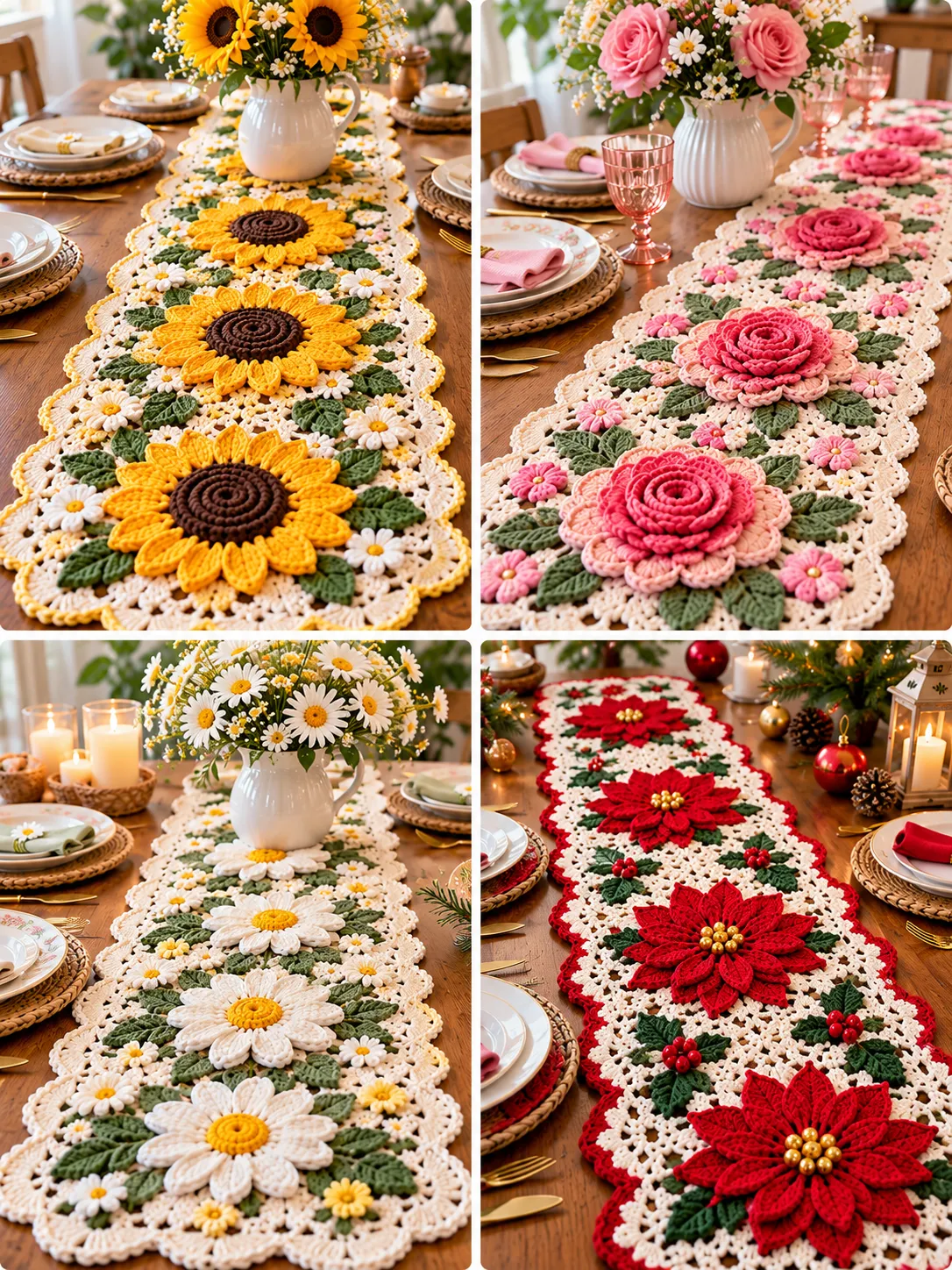
This title is close to the earlier table runner articles (flowers, cottagecore, sunflower, luxury lace, granny squares, diamond lace, Christmas ripple, and shell stitch), so I chose a new design: a harvest runner with a raised texture stitch in warm oat and rust. It is worked in simple stripes with a textured stitch that looks like woven wheat, and it has a fringe at each end instead of a lace border. It suits a dining table, a farmhouse sideboard, or an autumn or Thanksgiving centerpiece.
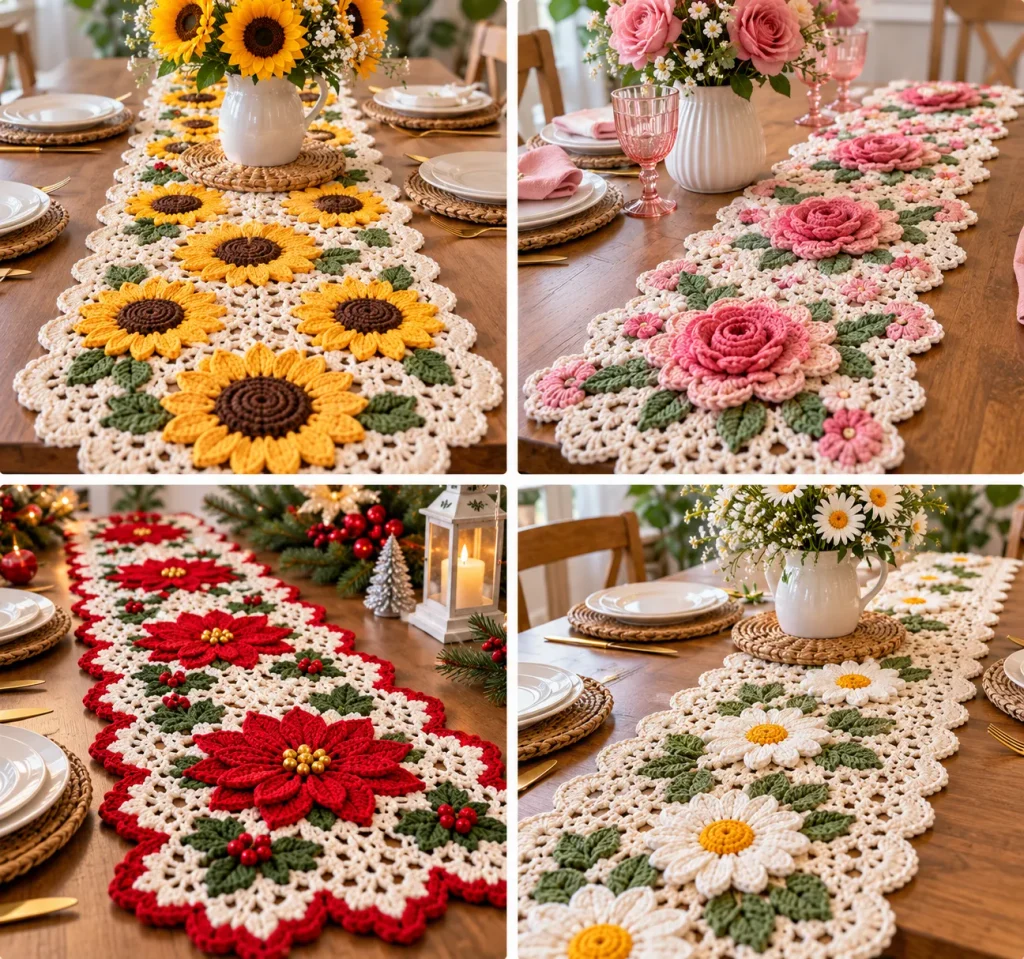
Pattern Information
Skill level: Beginner to intermediate, with a simple repeat and color changes.
Terms: US crochet terminology.
Construction: The runner is worked flat in turned rows from a long foundation chain. Stripes are changed every 4 rows. Fringe is added to the short ends.
Estimated size: About 30 × 110 cm (12 × 43 in) excluding the fringe. Actual dimensions depend on yarn, tension, and blocking.
Pattern note: This is an original design based on the title concept. Stitch counts have been checked, but the pattern has not been physically crocheted or independently tested. Make a swatch first and adjust the hook size to your tension.
Materials
- Worsted-weight cotton yarn in oatmeal or cream, approximately 200 g.
- Rust or terracotta, approximately 120 g, for the stripes and fringe.
- A 5 mm hook as a starting point (adjust to your tension).
- Tapestry needle, scissors, stitch markers, and a piece of cardboard about 15 cm (6 in) wide for cutting the fringe.
- Blocking mats and a spray bottle.
Stitches and Abbreviations
| Abbreviation | Meaning |
|---|---|
| ch | chain |
| sl st | slip stitch |
| sc | single crochet |
| hdc | half double crochet |
| sp | space |
| st(s) | stitch(es) |
Numbers in brackets give the stitch count at the end of each row. Turning chains do not count as stitches unless stated.
Before You Begin
The textured stitch is a simple “alternating sc and ch-1” pattern, so every row is built over the ch-1 spaces of the row before. Work a swatch of 20 stitches and 8 rows first. The fabric should be dense but flexible, like woven cloth. If it feels stiff, go up half a hook size.
To change the width, use a foundation chain that is an even number plus 1. Each additional 2 chains adds about 2.5 cm (1 in).
Color Sequence
Work 4 rows of each color in this order, and repeat:
Rows 1–4: oatmeal
Rows 5–8: rust
Rows 9–12: oatmeal
Repeat this 12-row block until the runner reaches about 110 cm. Carry the unused yarn loosely up the side, or cut it and weave in the ends later. Change color on the last yarn-over of the final stitch of the row before.
Runner Body
The runner is worked along its length, so each row is the full length of the table.
With oatmeal, ch 221.
Row 1: Sc in the 2nd ch from hook. Ch 1, skip 1 ch, sc in the next ch. Repeat from * across. Turn. [110 ch-1 sps, 111 sc]
Row 2: Ch 1, sc in the first sc. Ch 1, skip 1 sc, sc in the next ch-1 sp. Repeat from * across, ending with sc in the last sc. Turn. [110 ch-1 sps, 111 sc]
Row 3: Ch 1, sc in the first sc. Sc in the next ch-1 sp, ch 1, skip the next sc. Repeat from * across, ending with sc in the last sc. Turn. [110 ch-1 sps, 111 sc]
Rows 4–44: Repeat Rows 2 and 3, following the color sequence above. End with an even row (Row 44). Fasten off.
Why the counts hold: In every row, you work 1 sc into each ch-1 space of the row below and 1 ch-1 over each sc. This keeps 111 sc and 110 ch-1 spaces in every row.
Note: with a worsted-weight yarn and a 5 mm hook, 44 rows measure roughly 30 cm. Add rows in groups of 12 to keep the color pattern balanced.
Fringe
Wrap rust yarn around the cardboard 36 times, and cut along one edge. This gives 36 strands, each 30 cm (12 in) long. For each tassel, fold 3 strands in half, pull the loop through an end stitch with your hook, thread the ends through the loop, and pull snug. Space the tassels about 2.5 cm (1 in) apart across each short end (12 tassels per end). Trim the fringe straight to about 10 cm (4 in).
Finishing and Blocking
Weave in all ends. Wash the runner gently in cool water with a drop of mild soap, press out the water in a towel, and pin it flat on a blocking mat with the long edges straight. Let it dry completely before unpinning.
Practical Tips and Troubleshooting
The edges look wavy. Count the stitches at the end of every row. The row should always have 111 sc and 110 ch-1 spaces.
The fabric is too stiff. Go up half a hook size, or make the ch-1 spaces slightly looser.
The stripes look messy at the edge. Change color on the last yarn-over of the final stitch of the row. The fringe will hide any small jog.
The runner curls. Block it firmly and check that your first and last stitches are not too tight.
The color changes leave long strands. Carry the yarn up the side for 4-row stripes only. For longer gaps, cut the yarn and weave in the ends.
FAQ
Can I use thread instead of yarn? Yes. Use size 10 cotton thread and a 1.75 mm hook. The runner will be much finer, so add more stitches and rows for the same size.
Can I use other colors? Yes. Try navy and cream for a coastal look, sage and ivory for spring, or red and cream for the holidays.
Can I make it wider? Yes. Add rows in groups of 12, or add more stitches to the foundation chain in multiples of 2.
Do I need to block it? It is recommended. Blocking evens out the texture and keeps the long edges straight.
More Free Crochet Patterns
- Free Crochet Table Runner Pattern (Shell Stitch)
- Free Crochet Table Runner Pattern (Christmas Ripple)
- Cottagecore Crochet Table Runner Pattern
Save This Pattern
Pin this Free Crochet Table Runner Pattern to your Pinterest board for your next harvest or dining table project. Happy crocheting!